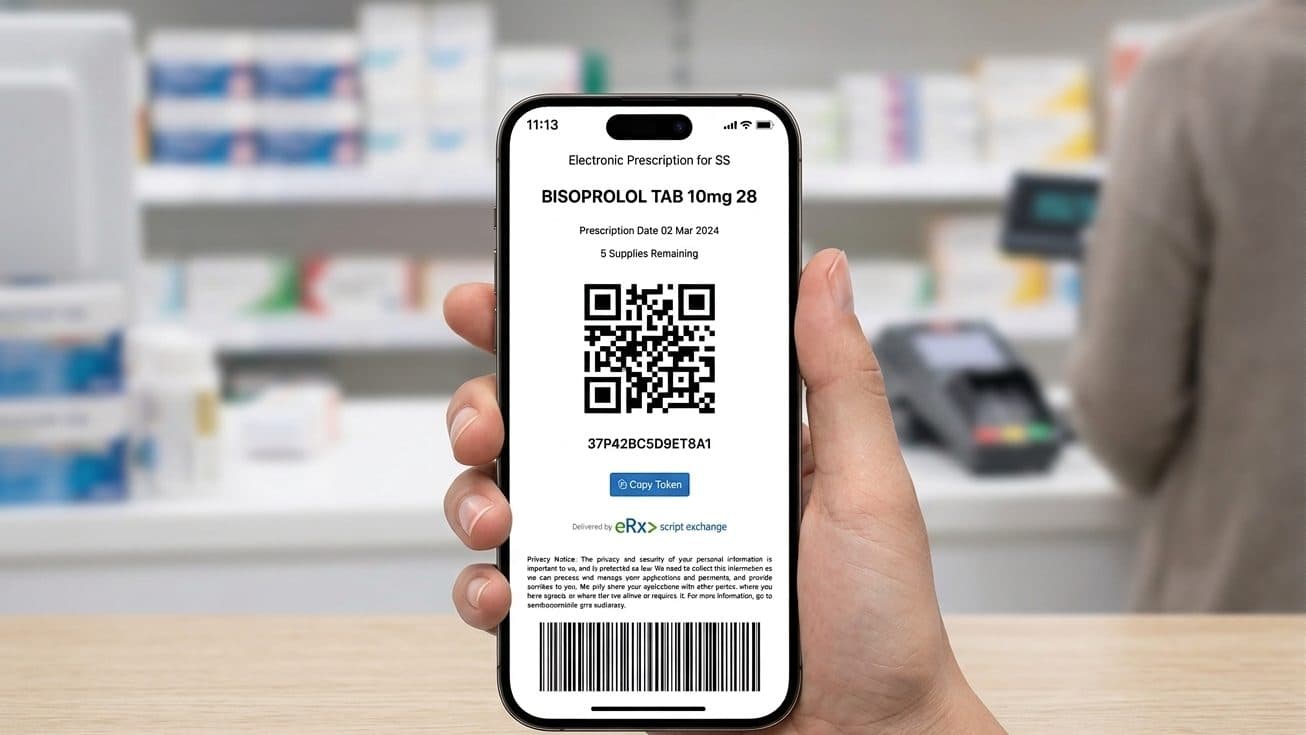
Changing pharmacies partway through a prescription is usually simpler than people expect, and in many cases there is nothing to move at all. Healthdirect notes that an electronic prescription can go to any pharmacy set up to dispense it, and a paper script works the same way, so the pharmacy you started with does not have to be the one you finish with.
General information, not medical advice
This guide explains how things work in general. It cannot tell you what is right for you, so check anything that affects you with your pharmacist or GP.
Always read the label and follow the directions for use.
Based on official Australian government and health sources. Rules can change.
How it works depends on whether your prescription is electronic or on paper. Electronic prescriptions, or eScripts, have been available across Australia since 2020, and most pharmacies are set up to dispense them. If you are new to how scripts work, our guide to prescriptions in Australia covers the basics, and our eScripts guide explains the electronic version in detail.
The short version: an eScript is not tied to a pharmacy, so you present or forward your token wherever you want to go. A paper prescription is a physical document you carry with you. Repeats are the part that occasionally needs a phone call.
An electronic prescription is not tied to any pharmacy
When your prescriber issues an eScript, they send a link to a token by text message or email, and that token is your prescription. You get one token for each medicine. Because the token lives on your phone, any pharmacy equipped for eScripts can dispense from it, and Healthdirect notes that covers most of them.
The Australian Digital Health Agency lists three ways to collect at a pharmacy of your choice: show the token at the counter, where staff scan the QR (Quick Response) code on your phone; forward the text message or email so the medicine is ready to collect or delivered where that service is offered; or forward the token to a family member or carer, who can collect it for you.
Moving an eScript to a new pharmacy takes four steps, and none of them involves your old pharmacy.
Nothing has to be arranged with your old pharmacy. If you have signed up for an Active Script List, which keeps all your tokens in one place, you can visit any participating pharmacy and give consent for staff to see the list instead of showing a token. If a token will not open or you have lost the message, the Digital Health Agency says to contact the prescriber for an original prescription, or the pharmacy that issued it for a repeat. Our eScript troubleshooting guide covers the common errors.
A paper prescription is a document you carry with you
Some prescribers still issue a paper or barcoded prescription, and pharmacists are legally required to receive that paper copy before they dispense. A paper script is not registered to one shop. The Digital Health Agency says a prescription is valid for the same period whether it is electronic or paper, in most cases 12 months, shorter for some medicines and subject to state or territory law, so you can take an original paper script to any approved pharmacy until that date.
Because the paper is not tied to the pharmacy that would have dispensed it, you are not obliged to return there. You can take it to any approved pharmacy, where it is dispensed on presentation.
Hand the original in at any approved pharmacy, and it is dispensed on presentation.

Repeats you have already started
Repeats are where moving pharmacies becomes a real question, because a repeat sits somewhere after the first supply.
With an eScript, the pharmacy that dispenses each supply sends you a fresh token by text message or email for the next repeat. That new token is not locked to that pharmacy, so you can use it somewhere else next time. If you would rather hold a paper copy, Healthdirect says you can ask the pharmacist to print your repeat as a paper prescription.
With a paper prescription, the remaining repeats are often held at the pharmacy that gave you the first supply. If yours are, you can ask that pharmacy for the repeat authorisation to take elsewhere, or ask it to pass your record to the new pharmacy. Paper repeats for Schedule 8 controlled medicines follow stricter state rules, which are covered in the section on what you cannot split or move. Our repeat prescriptions guide covers how repeats work across pharmacies.
What to have ready when you switch
Switching is mostly a matter of turning up with the right things in your bag. Have these ready before you go.
- Your phone. Your eScript token sits in the text message or email, or in your Active Script List.
- Any paper script. The pharmacy needs the original paper or barcoded copy before it can dispense.
- A paper repeat authorisation. If your repeats are held on paper, bring the authorisation, or ask your old pharmacy to pass your record over.
- Your Medicare card and Safety Net record form. The card is needed for the Pharmaceutical Benefits Scheme (PBS) subsidy, and the record form lets the new pharmacy add your purchases to your Safety Net total.
Your Safety Net does not reset when you change pharmacy
Your PBS Safety Net lowers the cost of medicines once your spending passes a yearly threshold. Your spending is recorded on a PBS Safety Net prescription record form (the PB240 form), or on a record printed from the pharmacy's dispensing system. The PBS Safety Net rules say you keep the form and give it to the pharmacist each time you have a PBS medicine dispensed at any approved pharmacy, and recommend using it to track your spending if you use more than one pharmacy. Changing pharmacy does not erase what you have already spent, as long as each purchase is recorded, and once your recorded total reaches the threshold, the pharmacist issues your Safety Net card. If you spent over the threshold before you had your card, you may be able to claim a refund. For Medicare and Safety Net enquiries, Services Australia can be reached on 132 011.
Your PBS spending for the calendar year is tracked on the record form you keep, so switching pharmacy does not erase it, provided each pharmacy records your purchases on the form.
Prices for the same medicine can also differ between pharmacies. Our guide to comparing script prices explains what changes the amount you pay, and our private versus PBS prescriptions guide covers why two scripts for one medicine can cost different amounts.
What you cannot split or move
A prescription is dispensed as a single supply at one pharmacy, so you cannot take part of it at one shop and the rest at another. This matters most for a 60-day prescription, which the Department of Health describes as a two-month supply on a single prescription for a stable, ongoing condition. It is filled once, at one pharmacy, in one transaction. A 30-day supply works the same way.
You also cannot move a prescription that has been fully dispensed, repeats included, because there is nothing left on it. At that point your prescriber issues a new one.
Schedule 8 medicines, which the Therapeutic Goods Administration (TGA) classifies as controlled drugs, sit under tighter rules. The TGA sets the national schedule, but each state and territory gives it legal effect and regulates how these medicines are prescribed and supplied. The controls on moving one between pharmacies are set by your state or territory, and they are strictest for paper prescriptions. In NSW, NSW Health says a paper Schedule 8 prescription is kept at the pharmacy where it was first dispensed, and the repeats are dispensed there. In Western Australia, WA Health says paper Schedule 8 repeats are posted from the old pharmacy to the new one and are not returned to the patient. In both states, a repeat token for an electronic Schedule 8 prescription can be taken to a different pharmacy. Rules can differ in other states and territories, so it is worth asking your pharmacist before you plan to move a paper Schedule 8 repeat.
Reasons people change pharmacy
You do not need a reason to change pharmacy; the choice is yours. Common ones include moving house, suburb or state, your usual pharmacy being closed when a repeat is due, a pharmacy closer to home, work or the doctor, home or same-day delivery, or a better price on a particular brand.
eScript versus paper script: what to do for each
The table below sums up what to do for each type of prescription, and when the old pharmacy is involved.
| Your prescription | To use a different pharmacy | Old pharmacy involved? |
|---|---|---|
| eScript (token on your phone) | Show or forward the token, or use your Active Script List | No |
| Paper or barcoded script, not yet dispensed | Hand the paper in at the new pharmacy | No |
| Repeats after the first supply | Use the fresh eScript token anywhere, or take a paper repeat authorisation with you | Only if paper repeats are held there |
Talk to someone now
Free advice for questions about a medicine, dose, or interaction.
Frequently asked questions
Not for a new eScript or an original paper script, because neither is registered to a single pharmacy. The only time you contact the old pharmacy is when it is holding paper repeats for you, and then you are asking for the repeat authorisation, not for permission to leave.
You pay the usual price for the medicine at whichever pharmacy dispenses it, either the PBS co-payment or the private price, and that price can differ a little between pharmacies. For PBS medicines in 2026, a pharmacist may choose to take up to $0.60 off the concession co-payment, or give a general patient a discount on a medicine priced above $25.00 and below $51.10. These amounts are set by the government and usually change on 1st January.
Your eScripts are not affected, because the tokens sit on your phone or in your Active Script List, so you can use another pharmacy straight away. If paper repeats were held at the closed pharmacy, your prescriber can issue a fresh prescription, though a new appointment may be needed.
No. A token is spent once that supply is dispensed. If your script has repeats, each repeat arrives as a new token and you can choose a different pharmacy for each supply, but one supply is filled in one place.
The physical script is what the pharmacy needs, because the pharmacist is legally required to receive the paper copy before dispensing, even when a barcoded paper script also appears on an Active Script List. A paper prescription is usually valid for 12 months from the date it was written, and for less time for some medicines, including Schedule 8 medicines in some states. Once that period has passed, it cannot be filled, and you would need a fresh one from your prescriber. Find a pharmacy near you: browse Australian pharmacies.