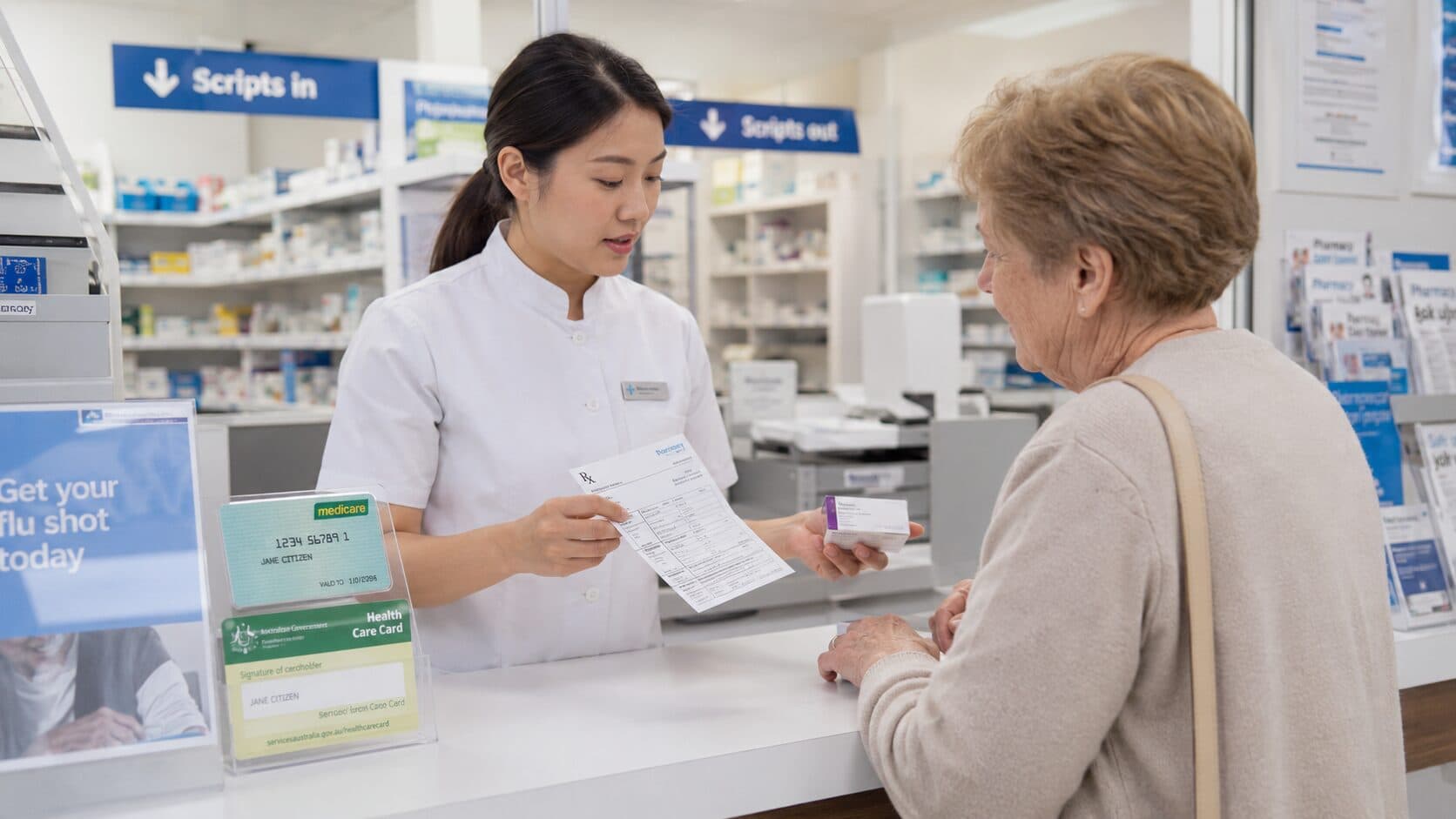
The Pharmaceutical Benefits Scheme, or PBS, is how the Australian Government keeps the cost of most prescription medicines within reach. It subsidises about 80% of all prescription medicines, so instead of paying a chemist's full price you pay a set contribution and the government covers the rest, according to the Department of Health, Disability and Ageing.
General information, not medical advice
This guide explains how things work in general. It cannot tell you what is right for you, so check anything that affects you with your pharmacist or GP.
Always read the label and follow the directions for use.
Based on official Australian government and health sources. Rules can change.
In 2026 that contribution, called the co-payment, is capped at $25.00 per script for a general patient, or $7.70 if you hold a concession card, as published by the PBS. The general figure fell from $31.60 on 1st January 2026 under the Cheaper Medicines reforms, a reduction rather than the yearly increase most patients had come to expect, as the Department of Health, Disability and Ageing explains.
This guide covers the national rules: what the PBS pays for, the difference between the general and concession rates, how the Safety Net caps your yearly spend, and the premiums that can push a single script above the co-payment. Related guides go deeper on applying for a card and comparing prices.
What the Pharmaceutical Benefits Scheme covers
The PBS is the federal medicines subsidy. A committee assesses each medicine for how well it works and whether it is worth the cost, as the PBS sets out, and for a listed medicine the government pays the remaining cost above your co-payment, apart from any premium and certain other allowable charges, according to the PBS patient fees page. Many listed medicines would otherwise cost hundreds or thousands of dollars per script.
The full list sits at pbs.gov.au and updates monthly. A medicine on the list is described as PBS-listed. A medicine that is not listed, or a script written outside the conditions the PBS attaches to a listing, is a private prescription, where you pay the full price and it can differ between pharmacies. Our guide to private and PBS prescriptions works through that split.
The PBS is available to Australian residents with a Medicare card, and to visitors from countries that hold a Reciprocal Health Care Agreement with Australia, according to the PBS. Most listed medicines are dispensed by a community pharmacist and taken at home. Medicines that need close medical supervision, including chemotherapy, run through separate hospital and specialised arrangements.
What you pay: the general and concession co-payments
What you pay at the counter for a PBS-listed medicine depends on whether you hold a recognised concession card.
A general patient, meaning anyone without one of those cards, pays up to $25.00 per script in 2026, per the PBS. This general amount will be adjusted again each 1st January from 2027 in line with the Consumer Price Index, the Department of Health, Disability and Ageing notes.
A concession cardholder pays up to $7.70 per script. That concession rate is held at $7.70 and will not rise until it is next adjusted on 1st January 2030, again per the Department of Health, Disability and Ageing. You show the card each time you fill a script and the pharmacy applies the lower rate at the counter, with no separate paperwork.
The gap between the two rates is wide, and a concession card holder pays less than a third of what a general patient pays for the same script.
Source: PBS co-payment amounts, 2026.
If a medicine's dispensed price is below the co-payment, a general patient pays that lower price rather than the full amount, though the pharmacist may add a small allowable charge that cannot take the total above the co-payment, the PBS explains. This is increasingly common for older generics whose price has fallen under $25.00, and it is one reason the same script can cost a little less at one pharmacy than another. Our guide to what a concession card saves you puts numbers to the difference.
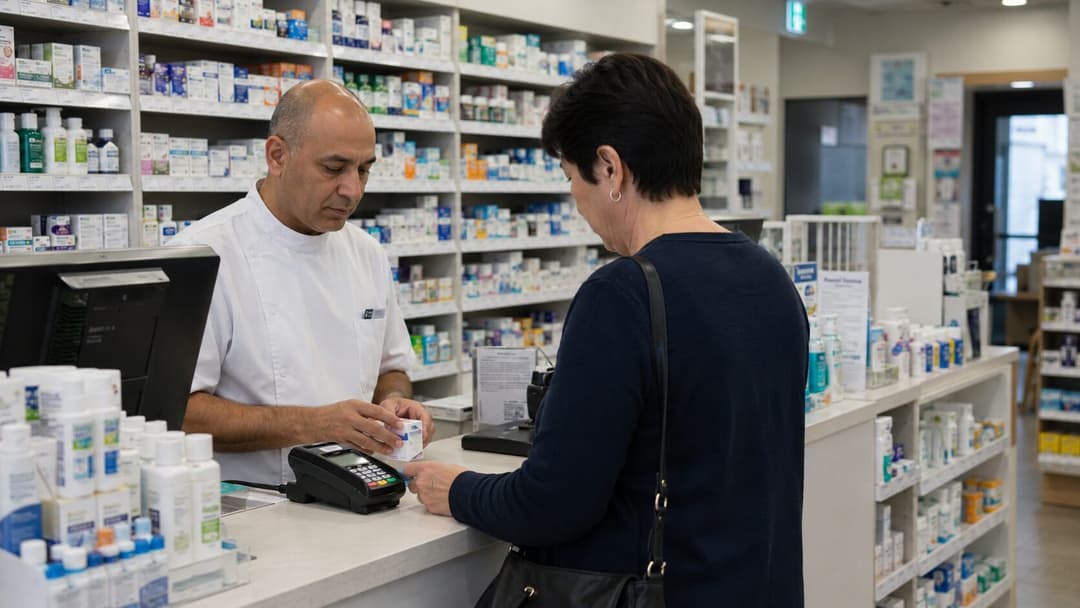
Some generics cost less than the $25.00 general co-payment, and the PBS says you pay the lower price, although a pharmacy may add an optional charge of up to $2.79 as long as the total stays at or under $25.00, so the same script can cost less at a different pharmacy.
Who qualifies for the concession rate
The concession co-payment applies if you hold one of the cards Services Australia or the Department of Veterans' Affairs issues. The PBS explanatory notes list the Pensioner Concession Card, the Health Care Card, the Commonwealth Seniors Health Card, and the Department of Veterans' Affairs Gold or Orange Card. A DVA White Card gives the concession rate only for RPBS prescriptions, as the section on veterans below explains.
The cards that qualify are issued by Services Australia or the Department of Veterans' Affairs, so a state or territory Seniors Card on its own does not bring the co-payment down to $7.70. Many people assume it does.
The Safety Net, and what changes once you reach it
The Safety Net protects you from the running cost of medicines across a calendar year. Once your family's eligible PBS spending passes the threshold, further scripts for the rest of that year cost less. The PBS sets the 2026 thresholds and the rates that follow.
| Patient type | Co-payment per script | Safety Net threshold, per family per year | Cost per script after the threshold |
|---|---|---|---|
| General | $25.00 | $1,748.20 | $7.70 |
| Concession | $7.70 | $277.20 | No co-payment (premiums still apply) |
PBS co-payment amounts and Safety Net thresholds, 2026.
After a general patient reaches the threshold, further PBS scripts drop to the concession rate of $7.70 for the rest of the year, and after a concession cardholder reaches theirs, further scripts are free apart from any brand or therapeutic group premium, the PBS confirms. The threshold resets on 1st January and spending does not carry over, so crossing it late in December buys only a short benefit before the count starts again.
A Safety Net family combines one threshold across you, your partner, your children under 16 in your care, and dependent full-time students under 25, according to Services Australia. A household with several people on regular medicines often reaches the threshold sooner than one person would alone. Our guide to the PBS Safety Net walks through the mechanics in more detail.
Across a calendar year the Safety Net moves through four stages.
Source: PBS co-payment amounts and Safety Net thresholds, 2026.
What counts toward the Safety Net, and what does not
Most PBS spending counts. The co-payment on each PBS-listed script you fill usually goes toward your yearly total, recorded on a Prescription Record Form, or PRF. According to the PBS, keeping that form is your responsibility, although your pharmacy may hold it for you.
Some spending sits outside the count. The PBS Safety Net notes state that a brand premium does not count toward the Safety Net, and the same applies to a therapeutic group premium. Private prescriptions that are not PBS-listed, over-the-counter medicines bought without a script, and general pharmacy purchases like vitamins and supplements do not count either. If you are unsure whether a given medicine will count, the pharmacist can tell you before dispensing.
How the Safety Net card reaches you
The Safety Net card is issued by a pharmacist, based on your Safety Net prescription record form. Once the form shows that you or your family have reached the threshold, the pharmacist can issue the card, and you show it each time you fill a script for the rest of that year, as the PBS describes.
If you crossed the threshold without a card being issued, which can happen when your scripts are spread across different pharmacies, Services Australia explains that you can claim back the extra you paid with the Patient claim for refund Pharmaceutical Benefits Scheme (PBS) form. A pharmacist can still issue the card once your record form shows the threshold has been reached. Our step-by-step guide to applying for a Safety Net card covers each step in more detail.
Once your prescription record form shows you have reached the threshold, the pharmacist can issue the card at the counter, so it is worth handing over the form each time you fill a script.

The Closing the Gap co-payment program
Aboriginal and Torres Strait Islander patients may pay less again through the Closing the Gap, or CTG, PBS Co-payment Program. A prescriber or Aboriginal Health Practitioner registers an eligible person once, for life, and from then on the reduced rate applies at an approved pharmacy, according to the PBS.
Under the program, a patient who would normally pay the general co-payment pays the concession rate instead, and a patient who already holds a concession card receives eligible PBS medicines for free, the same source states. Registration is arranged through the health professional rather than the patient, and a brand premium still applies where the patient chooses a more expensive brand.
Brand premiums and therapeutic group premiums
A brand premium is the extra amount you pay when you choose a brand that costs more than the lowest-priced brand of the same medicine. The government subsidises every brand up to the price of the cheapest one, so any difference above that is charged to you, the PBS sets out. The lowest-priced brand carries no premium, so you can avoid the charge by choosing it.
A therapeutic group premium works the same way across a group of medicines that can be used interchangeably: the government subsidises the group up to the price of the lowest-cost option, and any difference is yours to pay, per the PBS. Each group keeps at least one option with no premium, and a doctor can seek an exemption where there is a medical reason you can only take the more expensive one. Because neither premium counts toward the Safety Net, a premium is the usual reason a script costs more than the headline co-payment.
Generic and brand-name medicines
A generic medicine carries the same active ingredient, in the same strength and form, as the original brand. According to the PBS, brands are listed as substitutable where the manufacturer has shown they are bioequivalent or therapeutically equivalent, and healthdirect explains that a generic can cost less because its maker has not spent money on the medicine's discovery, development and marketing.
For PBS purposes, interchangeable brands of a medicine appear under one listing and you pay the same co-payment whichever you receive. A pharmacist can usually offer a premium-free brand and, where your prescriber has allowed substitution, swap to it at your request. If your prescriber has marked a script so the brand cannot be substituted, that choice stands, and any premium on it applies.
How 60-day prescriptions change your yearly cost
For many stable, long-term conditions, a prescriber can now write a 60-day script, dispensing two months of medicine at once instead of one, as listed by the PBS. The eligible list has grown in stages since the change began.
The effect for you is fewer trips to the pharmacy and fewer co-payments across the year. Someone stable on a single medicine might fill six scripts a year rather than twelve, roughly halving what they spend on it. That slower spend also means reaching the Safety Net later, or sometimes not at all if you take only one medicine. Your prescriber decides whether a 60-day quantity suits your medicine and your condition. Our guide to 60-day prescriptions covers who is eligible.
How to keep track of your Safety Net spending
Your PBS spending does not add up automatically across different pharmacies, so tracking it is partly up to you, Services Australia explains. The simplest approach is to use one pharmacy for all your scripts and ask it to keep a record, so it can tell you when you are close to the threshold. If you use more than one pharmacy, keep your own running total on a PBS Safety Net prescription record form, the PB240, which each pharmacy can add to, or ask each one for a printout of what you have spent.
Once your record shows you have reached the threshold, the pharmacy can issue your Safety Net card. If you need the line-by-line history of what you have been dispensed, your My Health Record holds it.
Why the same script can cost different amounts
A single PBS medicine can come to a different total at two pharmacies for a few legitimate reasons: a brand premium on the version you chose, a private script that the PBS does not subsidise, or a medicine priced below the co-payment being charged at its lower actual price. Our guide to why a script is cheaper at another pharmacy sets out each case, and our overview of how prescriptions work in Australia covers the rest of the journey from prescriber to counter.
Veterans and the Repatriation scheme
Veterans and their dependants are covered by a parallel scheme, the Repatriation Pharmaceutical Benefits Scheme, or RPBS, administered by the Department of Veterans' Affairs, or DVA. Holders of a DVA Gold or Orange Card pay the concession rate, or no co-payment once they have reached the Safety Net, although any premium still applies. Holders of a DVA White Card pay the concession rate for RPBS prescriptions, and are otherwise treated as general patients unless they also hold a Centrelink concession card, according to the PBS explanatory notes. Gold and Orange cardholders can also access a broader range of medicines than a White cardholder.
Some medicines that are not on the general PBS are listed on the RPBS, particularly for service-related conditions. A veteran unsure what a card covers can check with the Department of Veterans' Affairs.
Talk to someone now
Free advice for questions about a medicine, dose, or interaction.
Frequently asked questions
General patients pay up to $25.00 for a PBS script in 2026. The amount fell from $31.60 at the start of the year and is the most a general patient pays before any Safety Net or premium is taken into account.
No. It stays at $7.70 a script and is deliberately frozen, so unlike the general rate it is not adjusted for inflation each January. The next scheduled adjustment is 1st January 2030.
Once your family's eligible PBS spending reaches $1,748.20 for general patients, or $277.20 for concession cardholders, in a single calendar year. After that, general scripts drop to $7.70 and concession scripts are free, apart from any brand or therapeutic group premium, until 31st December, when the count starts over.
Across a household. The scheme applies one threshold to a family unit rather than to each person, so a couple or a family reaches it on their combined scripts. If members fill scripts at different pharmacies, keeping receipts or a single record helps make sure nothing is missed from the tally.
Usually because of an extra charge the PBS allows on top of the co-payment: a brand premium (for a brand that costs more than the cheapest one), a therapeutic group premium, or a special patient contribution. A private prescription, which the PBS does not subsidise, can also cost more. Your pharmacist can tell you whether an option with no extra charge is available.
Yes, through the Closing the Gap PBS Co-payment Program. A prescriber or health practitioner registers an eligible person once, with nothing to renew afterward, and it is open at any age. The saving then applies automatically whenever an approved pharmacy fills an eligible script. Find a pharmacy near you: browse Australian pharmacies.