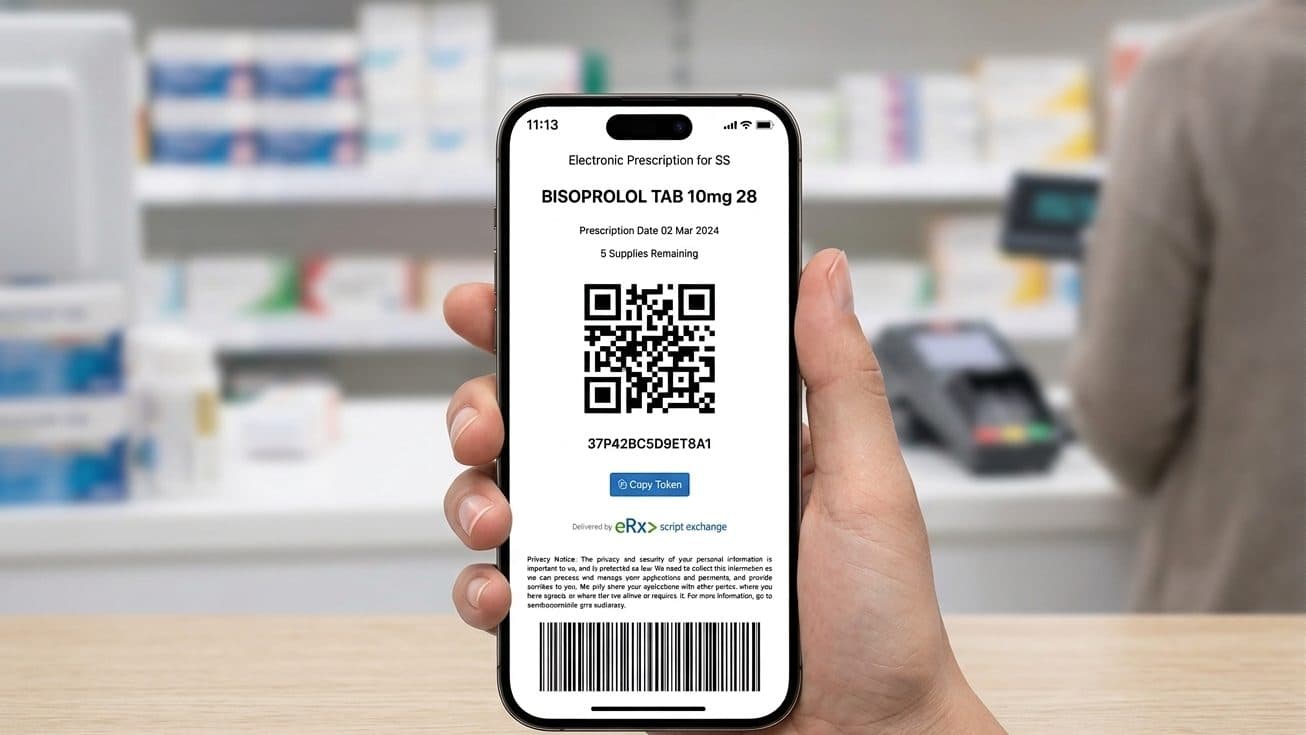
A repeat authorises another supply of the same medicine under the original prescription. The number written on the script tells you how many further times it can be dispensed before you need a new prescription (About prescriptions, Department of Health, Disability and Ageing).
General information, not medical advice
This guide explains how things work in general. It cannot tell you what is right for you, so check anything that affects you with your pharmacist or GP.
Always read the label and follow the directions for use.
Based on official Australian government and health sources. Rules can change.
This guide explains when repeats can be filled, how electronic and paper repeats are handled, what happens when a repeat is requested early and what to do when the prescription has expired or has no supplies left.
Repeats exist for medicines you take continuously, so a stable condition does not send you back to a general practitioner (GP) every month. The rules that set how many repeats you get, and how long they last, come from the Pharmaceutical Benefits Scheme (PBS) and from state and territory law for controlled medicines. For how the whole prescription system fits together, see our guide to prescriptions in Australia and our explainer on the Pharmaceutical Benefits Scheme.
What a repeat prescription is
A repeat is a pre-authorised further supply of the same prescription. When your prescriber writes the script, they set the number of repeats, and the Australian Government lists that number as one of the mandatory details a prescription must carry.
If your prescriber writes five repeats, you can have the medicine dispensed six times in total from that one prescription: the first supply plus five more. Each supply gives you the quantity written on the script, commonly 30 days and, for many ongoing medicines, 60 days under the 60-day prescription rule.
The PBS explanatory notes for pharmacists are firm on the limit: a pharmaceutical benefit cannot be supplied more times than the prescription specifies. The pharmacist works to the number on your script, not a number you or they can adjust.
How many repeats a prescription can carry
The maximum number of repeats is set per medicine on the PBS Schedule, not chosen freely by your prescriber. Five repeats is the common ceiling for everyday medicines: the PBS explanatory notes refer to benefits that have five or more repeats allowed in the PBS Schedule as a standard category. Some medicines are held to fewer, and controlled medicines are treated more tightly again.
| Medicine category | Who sets the repeat limit | Typical repeats |
|---|---|---|
| Most PBS medicines | PBS Schedule | Up to 5 |
| PBS medicines with tighter listing rules | PBS Schedule | Fewer, sometimes 0 or 1 |
| Schedule 8 controlled medicines | PBS Schedule plus state and territory law | Fewer, with stricter monitoring |
| Private (non-PBS) prescriptions | Your prescriber | The prescriber's judgement |
repeat limits are set per medicine on the PBS Schedule and explanatory notes, with state and territory law applying to controlled medicines and private prescriptions set by your prescriber.
A private prescription is a medicine the PBS does not subsidise, so your prescriber sets the repeats within the rules for that medicine and you pay the full price, which can differ between pharmacies. Our private versus PBS prescription guide covers that difference, and our script cost comparison guide covers why the price can move between pharmacies.
How repeats work on an electronic prescription
An electronic prescription, or eScript, reaches you as a token: a link, usually holding a QR code, that your prescriber sends by SMS or email. The Australian Digital Health Agency explains that you get a separate token for each medicine, and that once a pharmacy scans a token and dispenses the medicine, that token is used up.
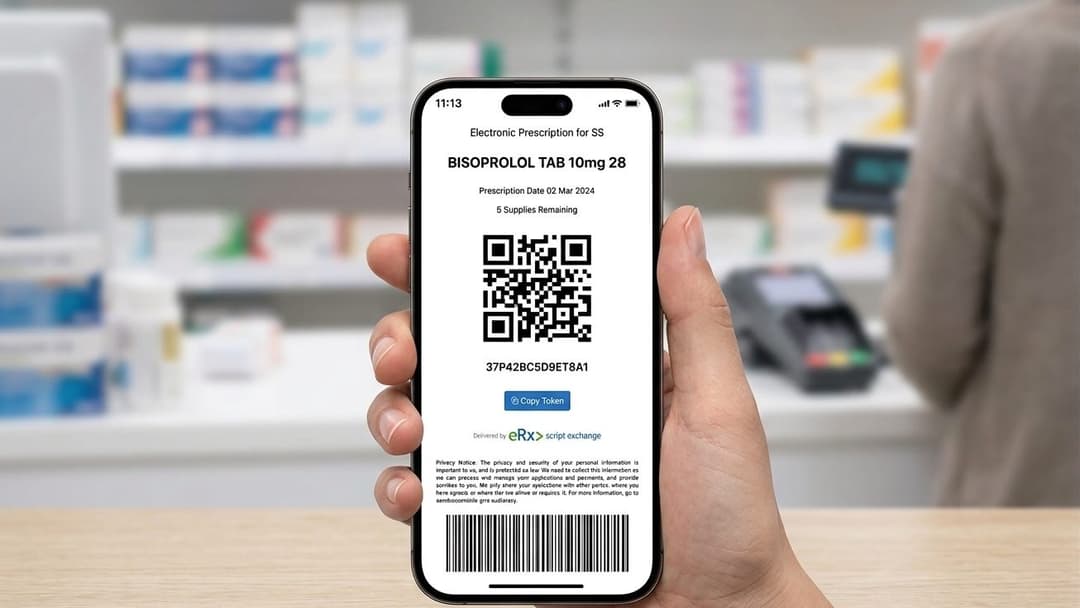
Your prescriber sends it by SMS or email, and once a pharmacy scans it that token is used up, with a fresh one following for each repeat you have left.
The repeats sit behind the scenes, and you only hold one token at a time. The Australian Digital Health Agency describes the cycle in four steps.
Because a new token comes from the pharmacy after each supply, you are free to use a different pharmacy for the next repeat, though most people settle on one. Our guide to transferring a prescription covers the mechanics when you do move, and our eScripts guide and eScript troubleshooting guide cover the rest. Most Australian pharmacies dispense from eScripts, so you can find a pharmacy that accepts eScripts wherever you fill your next repeat.
If you take several medicines, registering for an Active Script List (ASL) saves you tracking a separate token for each one. The Digital Health Agency describes the ASL as a single digital list of your electronic and barcoded paper prescriptions that a participating pharmacy can read with your consent, so your repeats live on the list rather than in your inbox. Our Active Script List guide explains how to register.
When a prescription and its repeats expire
A prescription and its repeats do not last forever. The PBS explanatory notes state that a pharmacist can dispense a repeat only up to 12 months after the date the original prescription was written. The Digital Health Agency confirms an eScript runs for the same period as a paper script, in most cases 12 months, and shorter for some medicines depending on the medicine and on state or territory rules.
The 12-month window moves through four stages, and the start point is the one most people misjudge.
Source: Supplying Medicines, PBS explanatory notes and Electronic prescriptions, Australian Digital Health Agency.
The clock runs from the date your prescriber wrote the script, not from your last supply. If you filled it in January and skipped to November, the repeats still expire the following January, and once the 12 months pass any unused repeats are gone. You cannot bank them, and you will need a new prescription.
Controlled medicines can expire sooner. The Digital Health Agency notes the validity period can be shorter for some medicines and can depend on state or territory legislation, and the Australian Government confirms that state and territory laws govern the use of some prescription medicines. Because the period varies by jurisdiction, your pharmacist can tell you the expiry that applies to a specific controlled medicine where you live.
If you run out before your next repeat
Sometimes the medicine runs low before a repeat is due, after travel, a dose change or a lost pack. If you still have a repeat left, the pharmacist may be able to supply it early. The PBS explanatory notes set a minimum gap between supplies of the same medicine (20 days for many medicines with five or more repeats), but the pharmacist can supply sooner if they believe the medicine is needed without delay, or if a previous supply was lost, destroyed or stolen. The pharmacist then writes "immediate supply necessary" on the prescription and signs it.
If you have no prescription or repeat left and cannot reach your prescriber, the PBS Continued Dispensing arrangement may help. The PBS explains that a pharmacist can supply up to the standard PBS quantity of an eligible medicine at the usual PBS price where there is an immediate need and the prescriber cannot be contacted or cannot provide an electronic prescription. Each medicine can be supplied this way only once in a 12-month period.
The PBS sets conditions on that supply. It advises the medicine must be one you were supplied in the last three months for a stable condition, and that the arrangement covers medicines mostly for ongoing conditions like asthma and other lung conditions, diabetes, high cholesterol and heart disease, plus oral contraceptives and medicines for human immunodeficiency virus (HIV). The PBS also notes that Schedule 8 controlled medicines are not eligible.
According to the PBS, each eligible medicine can be supplied this way only once in a 12-month period, and Schedule 8 controlled medicines are not eligible. The pharmacist decides whether the arrangement applies, so contact the pharmacy and your prescriber rather than relying on it as a guaranteed supply (Continued Dispensing, PBS).
If Continued Dispensing does not fit, the PBS points people to a telehealth appointment so a prescriber can send a script electronically, or a conversation with a community pharmacist about other options under state and territory emergency supply rules. For urgent health advice at any hour, Healthdirect runs a free line on 1800 022 222.
What happens when your repeats run out
When the last repeat is dispensed, no further tokens are generated and the prescription is finished. To continue the medicine, you see your prescriber for a new script. The Australian Government notes the maximum-repeats limit is the point at which you need to see your prescriber again, which is deliberate: it builds in a review of whether the medicine and dose still suit you.
A calmer approach is to plan the handover before you run out, and a few habits keep it smooth.
- Book a couple of weeks early. See your prescriber before your final repeat is due.
- Bundle any tests. A blood test or blood pressure check for a long-term medicine can happen at the same visit.
- Consider telehealth. Many services issue a fresh script without an in-person visit.
- Expect a yearly review. Prescribers often ask to see you once a year for ongoing medicines.
Talk to someone now
Free advice for questions about a medicine, dose, or interaction.
Frequently asked questions
Usually no. Repeats are meant to be spaced across the life of the prescription, and a pharmacist works to the supply pattern set by the medicine's PBS rules. Under Regulation 49 of the PBS regulations, a prescriber who is a doctor, midwife or nurse practitioner can mark a prescription so the pharmacist supplies the original and all repeats at one time, but that is the prescriber's decision, not something you arrange at the counter (Supplying Medicines, PBS explanatory notes).
No, and this is a common misread. Filling a repeat does not restart the clock. Validity is measured from the date your prescriber wrote the original prescription, so the last repeat expires 12 months after that writing date no matter how recently you collected the previous one (Supplying Medicines, PBS explanatory notes).
Each supply is charged as its own PBS co-payment, so you pay again at each fill rather than once for the whole prescription. Once your household reaches the PBS Safety Net for the year, the per-item cost drops. Prices can also differ between pharmacies, especially for private medicines and for brand price differences on PBS items (Fees, patient contributions and Safety Net thresholds, PBS).
Ask the pharmacist when new stock is expected. If another pharmacy has the medicine sooner, you can fill your repeat there instead. The Australian Digital Health Agency notes that you use each new repeat token at your preferred pharmacy. It is worth phoning ahead for less common medicines so the pharmacy can order the stock (Electronic prescriptions, Australian Digital Health Agency).
Yes. A paper prescription remains valid, its repeats are attached to the original form and used in order, and the same 12-month expiry applies. Barcoded paper scripts can also be loaded onto an Active Script List, so paper and electronic repeats can sit in one place (Electronic prescriptions, Australian Digital Health Agency).
You can ask for it to be resent. For the original prescription the request goes to your prescriber, and for a repeat it goes to the pharmacy that issued that token. Registering for an Active Script List avoids the problem, since your pharmacy reads your repeats from the list rather than from a token on your phone (Electronic prescriptions, Australian Digital Health Agency). Find a pharmacy near you: browse Australian pharmacies.