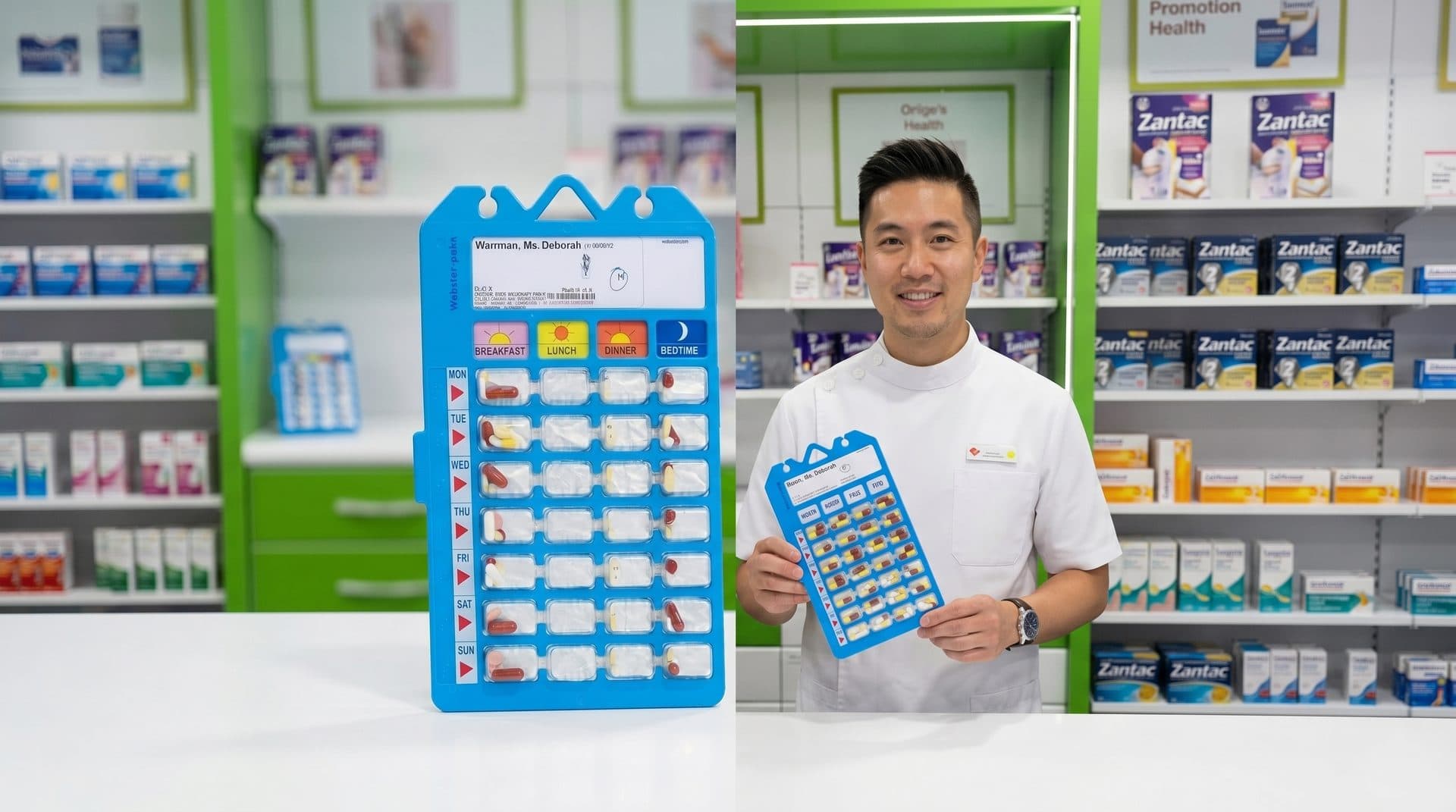
If you take several medicines a day, help someone else keep their doses in order, or have just come home from hospital with a changed list, an Australian community pharmacy can do a lot more than hand over the box. A pharmacist can sort your doses into a sealed weekly pack, sit down with you to go through everything you take, and, in some cases, arrange for a colleague to review your medicines in your own home.
General information, not medical advice
This guide explains how things work in general. It cannot tell you what is right for you, so check anything that affects you with your pharmacist or GP.
Always read the label and follow the directions for use.
Based on official Australian government and health sources. Rules can change.
Most of these supports are funded by the Australian Government through the Community Pharmacy Agreement and coordinated by the Pharmacy Programs Administrator, or PPA, which publishes the eligibility rules for each one. They are separate programs with separate criteria, so who qualifies for what is worth checking before you assume you are in or out.
This page is a map of what is available, who each support is for, and who pays. Where a service has its own detailed guide, we link across to it.
At a glance, here is what each support does and who it tends to suit. Each has its own section below and, where we have written one, a detailed guide.
| Support | What it does | Who it usually suits |
|---|---|---|
| Dose administration aid (Webster pack) | Sorts your doses into a sealed day-and-time pack | People juggling several regular daily medicines |
| MedsCheck | A one-on-one medicine review in the pharmacy | A quick check of a longer list or a recent change |
| Home Medicines Review | An accredited pharmacist reviews your medicines at home | A complex or unclear picture, often after hospital |
| Residential Medication Management Review | The equivalent home-style review for aged care residents | People living in residential aged care |
| Staged supply | A PBS medicine handed over in smaller instalments | When holding a full supply is a risk or hard to manage |
programs run and funded through the Pharmacy Programs Administrator.
When extra help with your medicines is worth it
Most people on one or two medicines manage them by memory and habit. The case for a more structured system grows as the list gets longer and the day gets busier. It is usually worth looking into once you are taking several regular medicines, because the more separate items you take, the easier it is to miss a dose, take one twice, or lose track of what each is for. More than one long-term condition adds to that: diabetes, heart failure, chronic obstructive pulmonary disease (COPD), kidney disease and dementia each carry their own schedule, and they often involve more than one prescriber.
Timing and circumstances matter too. The weeks after a hospital stay are a recognised high-risk window for medicine mix-ups, as new medicines get added, doses change and older ones stop. Memory or cognitive change tends to show up first in exactly this kind of routine, where remembering whether the morning tablets were taken slips early. And if you are caring for someone else, or getting to the pharmacy every week is hard, a clear, error-resistant system and home delivery move from convenient to necessary. If any of that describes you or someone you look after, the rest of this page covers the supports worth knowing about.
Dose administration aids and Webster packs
A dose administration aid (DAA) is a sealed, tamper-evident pack that holds each of your medicines sorted into the right day and time slot. The PPA describes it as a device that organises individual doses according to the schedule your prescriber has set. You peel back the foil or open the compartment at each dose time instead of opening several bottles.
"Webster pack" is one brand of dose administration aid, the Webster-pak, and the name has become the everyday term for the whole category. Other sealed-pack and sachet systems do the same job. The pharmacist sorts and seals the medicines, and if your medicines change partway through a week, they redo the remaining days, so it helps to let the pharmacy know as soon as something changes.
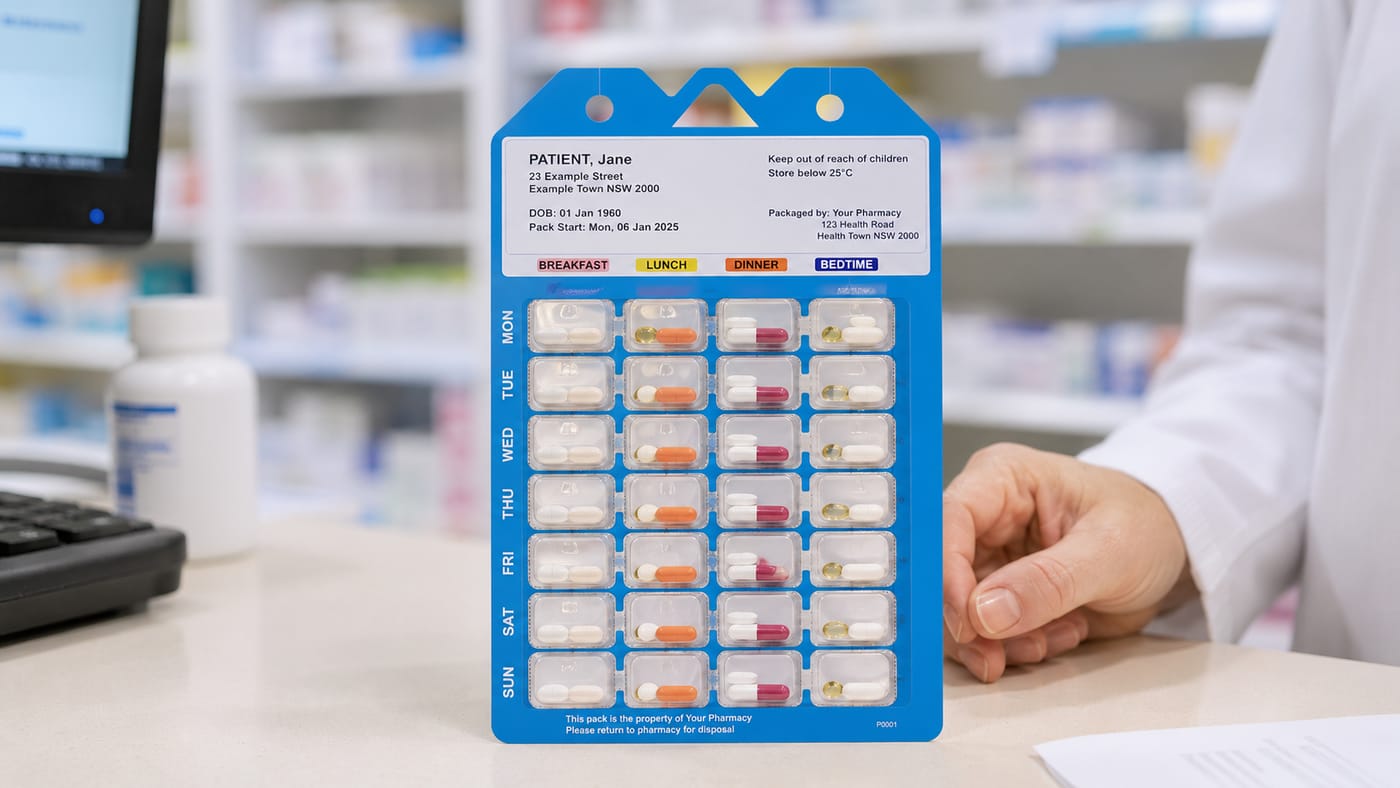
The name has become the everyday shorthand, though sachet and other sealed-pack systems sort each dose into the right day and time slot just the same.
A dose administration aid usually holds regular oral tablets and capsules, and can include regular daily supplements like vitamin D or calcium on request. It does not suit medicines taken only when needed, liquids, drops, creams, patches, inhalers, or medicines kept in the fridge like insulin, which stay separate.
More detail is in our guide to Webster packs and dose administration aids.
When a dose administration aid is subsidised, and when you pay
There are three patterns for who covers the packing.
The first is the federal DAA Program, run through the PPA, which pays a participating pharmacy a fee for each weekly pack it provides to an eligible patient. The program rules also allow the pharmacy to add its own charge at its discretion (except at a Remote Area Aboriginal Health Service). The PPA sets the patient criteria: you hold a Medicare or Department of Veterans' Affairs (DVA) card, live at home in the community, hold a valid government-issued concession card, and either have difficulty managing your medicines because of literacy, language, physical disability or cognitive difficulties, or take five or more prescription medicines and are finding them hard to manage. The concession card is a firm requirement, and the PPA notes that a Pharmaceutical Benefits Scheme (PBS) Safety Net card does not count as a concession card here. The program does not cover people who are hospital inpatients, aged care residents, or already funded through another government scheme like the DVA program.
The second pattern is a pharmacy that chooses not to charge for packing at all, whether or not you meet the federal criteria. The third is a weekly fee set by the pharmacy, which can apply to eligible patients as well as to people outside the program. Fees vary, so it is worth asking a few pharmacies what they charge.
Whichever pattern applies, you still pay the normal PBS patient co-payment for each medicine inside the pack. For aged care residents, packing is arranged separately through the residential aged care system rather than the community DAA Program.
Funded packing needs a valid government concession card, and a PBS Safety Net card does not count for this program. A pharmacy can add its own charge even when your packing is funded, and outside the program one pharmacy may not charge for packing while another sets a weekly fee, so it is worth confirming the arrangement when you set it up.
Our guide on who qualifies for a subsidised dose administration aid works through the eligibility rules in full.
MedsCheck and Diabetes MedsCheck: a review at the pharmacy
A MedsCheck is a one-on-one medicine review with your pharmacist in the pharmacy, in a private consultation area away from the counter. The PPA explains that it is aimed at improving how well you understand and use your medicines, working through any problems you have noticed, and agreeing on an action plan. You do not need a referral, and for eligible patients there is no charge for the review itself.
The PPA sets the funded eligibility: you are a Medicare or DVA cardholder, you have not had a MedsCheck, Diabetes MedsCheck, Home Medicines Review or Residential Medication Management Review in the previous 12 months, you live at home, and you either take five or more prescription medicines, have recently had a significant medical event, or take a medicine that carries a high risk of side effects. The service is not available to hospital inpatients or aged care residents. If you do not meet the criteria, or the pharmacy has reached its monthly funded limit, the pharmacist may still offer the review at your own cost.
There is a diabetes-specific version, the Diabetes MedsCheck, which the PPA offers to people who have type 2 diabetes that was diagnosed in the past 12 months or is not well controlled, and who cannot easily get to other diabetes education services. To arrange either review, the PPA's process is to ask your pharmacy and bring in everything you take, including over-the-counter medicines and supplements.
More detail is in our guide to MedsCheck and Home Medicines Review.
Home Medicines Review: an accredited pharmacist visits you at home
A Home Medicines Review (HMR) is a deeper review carried out in your own home by an accredited pharmacist, then reported back to the doctor who referred you. Unlike a MedsCheck, you cannot refer yourself. The PPA's HMR rules say the referral comes from your general practitioner (GP) or a relevant medical specialist, and that the service is not available to hospital inpatients or aged care residents.
Once referred, the accredited pharmacist arranges a time, comes to your home, and goes through every medicine alongside how you store, time and take them. They then write a report for your referring doctor, who decides on any changes and talks them through with you at your next appointment. Under the program the review is generally funded once in a 24-month period, or sooner if your referring doctor judges another review clinically necessary, and up to two follow-up visits can be funded where clinically indicated. An HMR is often most useful after a hospital stay, after a new medicine is added, or when you are no longer sure what you are taking and why.
A Home Medicines Review runs in four steps, from referral through to the follow-up conversation with your doctor.
For people who live permanently in a residential aged care home, an equivalent Residential Medication Management Review (RMMR) applies instead.
Here is how the two at-home and in-pharmacy reviews compare.
| Feature | MedsCheck | Home Medicines Review |
|---|---|---|
| Where it happens | In the pharmacy, in a private area | In your own home |
| Who runs it | Your community pharmacist | An accredited pharmacist |
| Referral | Not needed, you ask the pharmacy | Your GP or a relevant specialist refers you |
| How often it is funded | Once in a 12-month period | Generally once in a 24-month period |
| Best suited to | A quick check of a longer list or a recent change | A thorough review when the picture is complex or unclear |
Pharmacy Programs Administrator, which runs both programs.
Staged supply: medicines handed over in smaller amounts
Staged supply is an arrangement where a pharmacy hands over a PBS medicine in smaller instalments, for example daily or a few days at a time, rather than the whole quantity at once. The PPA explains that a prescriber requests it when they judge a patient could be at risk from holding a full supply, or when someone is finding it hard to manage a medicine safely at home.
The prescriber, pharmacy and patient agree how often the instalments are collected. For funded staged supply the PPA requires a Medicare or DVA card, a current concession card, and a prescriber referral, and the medicine has to fall within specific eligible categories. Where a patient is not eligible for funding, a pharmacy can still provide medicines in instalments at the patient's own cost. This is worth raising with your usual pharmacist if collecting a full supply at once is not workable.
Diabetes supplies through the National Diabetes Services Scheme
The National Diabetes Services Scheme (NDSS) is an Australian Government scheme, administered by Diabetes Australia, that gives registered people with diabetes access to subsidised supplies and support. The NDSS explains that registration is free, and once you are registered you collect products from an NDSS Access Point, which is usually a community pharmacy.
The NDSS lists the subsidised products it covers:
- blood glucose monitoring strips, with some restrictions for people with type 2 diabetes who do not use insulin
- insulin syringes and pen needles for people who use insulin
- insulin pump consumables for eligible people with type 1 diabetes
- continuous and flash glucose monitoring products for people with type 1 diabetes and certain other conditions who meet the eligibility criteria
A doctor, credentialed diabetes educator or other health professional can help you complete the registration form, and the NDSS Helpline on 1800 637 700 can answer questions about access.
Our guide to NDSS supplies at Australian pharmacies covers registration and what is subsidised in more detail.
Aged care and support at home
For people living in residential aged care, medicine management runs through the aged care system rather than the community programs above. The provider arranges supply with a contracted pharmacy. The community DAA Program does not cover residents, so it is worth asking the home whether there is any cost for packing. Residents are usually reviewed through the RMMR rather than a Home Medicines Review. Some homes instead have an on-site pharmacist through the Aged Care On-site Pharmacist measure, which the PPA administers. According to the Department of Health, Disability and Ageing, a home that takes part cannot also receive RMMR services from visiting pharmacists.
People receiving aged care at home, through the Support at Home program (which replaced Home Care Packages in November 2025) or the Commonwealth Home Support Programme, still live in the community, so the community programs above can apply if they meet each program's criteria. When someone moves between independent living, home care and residential care, the medicine record is easy to lose track of, so a review at the point of transition can catch a change that was missed.
Our guide to aged care pharmacist services sets out what is available for residents and people supported at home.
Help for carers and people living with dementia
For someone living with dementia, medicine routines change. Memory cues become less reliable, taste and swallowing can shift, and side effects can look like the condition itself. The pharmacist often becomes a more central point of contact.
A few approaches tend to help: keeping all medicines at one pharmacy so the dispensing record stays complete, using a dose administration aid with clear time-of-day labelling that can still be followed when memory for individual tablets fails, and asking for a Home Medicines Review that includes the main carer so the accredited pharmacist can talk through what works at home. Regular contact with the same pharmacist also means changes in side effects or behaviour often surface in conversation early.
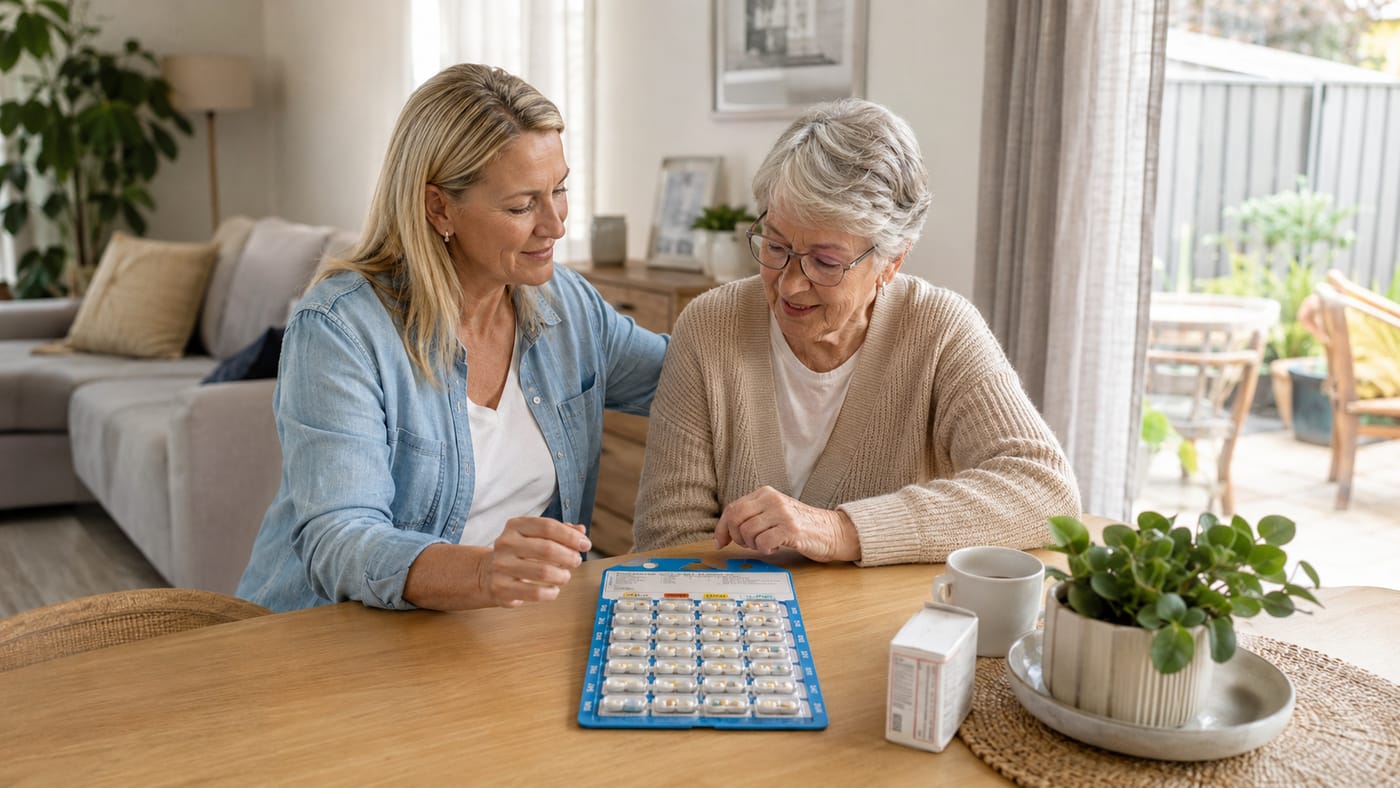

For clinical questions and support, Dementia Australia runs the National Dementia Helpline on 1800 100 500.
If you collect medicines for someone else, our guide to collecting medication on behalf of someone else explains what identification and authorisation a pharmacy may ask for, particularly for controlled medicines.
Why it helps to use one pharmacy
Most of the supports on this page work best when one pharmacy handles them together. The pharmacist sees your full list, the dispensing record stays complete, and the reminders and reviews reinforce each other rather than sitting in separate systems.
When you are deciding where to base your prescriptions, a few things are worth checking before you commit.
- Active Script List. Ask whether it offers ASL registration, so you are not forwarding a token for every script.
- Safety Net tracking. See if it tracks your PBS Safety Net spending and flags when you are close to the threshold.
- Dose aids and delivery. Confirm it provides dose administration aids and home delivery if you need them.
- A familiar pharmacist. The same person on most of your visits keeps the picture consistent.
- The programs you use. Check it takes part in the NDSS, the DAA Program and MedsCheck.
- A private area. A quiet space for a conversation that needs one.
Moving to a new pharmacy is straightforward: you forward your next electronic prescription token or transfer your remaining repeats, and our guide to repeat prescriptions explains the steps. Your PBS Safety Net spending is not combined across pharmacies automatically, so if you use more than one, the PBS explanatory notes recommend tracking it on the Safety Net prescription record form (PB240), which you keep, or on a printout from each pharmacy.
Talk to someone now
Free advice for questions about a medicine, dose, or interaction.
Frequently asked questions
No. A MedsCheck is something you can ask your pharmacist for directly, without a doctor's referral. A referral is only needed for the more detailed Home Medicines Review carried out at home.
Your general practitioner can, and so can a relevant medical specialist. If you think a home review would help, the starting point is to raise it with the doctor who manages most of your medicines.
No. Funded packing depends on holding an eligible government concession card and meeting the program's other criteria, and the PBS Safety Net card does not count for this purpose. A pharmacy can add its own charge even when the program funds your packing, and where the program does not apply, one pharmacy may not charge for packing while another sets a weekly fee, so it is worth confirming the arrangement when you set it up.
Yes. A pharmacist can set up a dose administration aid so daily doses are visible, review the full list through a MedsCheck or Home Medicines Review, and talk through issues like swallowing or storage. If you collect on someone's behalf, bring identification, as the pharmacy may need to confirm you are authorised for certain medicines.
It lets you collect a medicine across several smaller pickups, for example daily or every few days, instead of all at once. A prescriber sets it up where holding a large quantity could be a risk or is hard to manage safely, so if that would help you, it is worth raising with your prescriber or usual pharmacist.
Register with the NDSS first, which is free and can be done with the help of a doctor or diabetes educator. Once registered, you collect subsidised products from an NDSS Access Point, which is usually a community pharmacy, and the NDSS Helpline can point you to one nearby.
Bringing it in lets the admitting team see exactly what you have been taking. The hospital usually manages medicines during the stay, and your community pharmacist restarts the pack once you are home, updated with any changes. Find a pharmacy that offers dose administration aids and medicine reviews: browse pharmacies near you.