General information
This guide is general information, not personal medical advice, and may change over time. Always check anything that affects you with your pharmacist or GP. In an emergency, call 000.
A prescription in Australia is a legal authorisation, written by a registered prescriber, that lets a pharmacist dispense a specific medicine to you. In 2026 most prescriptions are issued electronically, most are filled under the Pharmaceutical Benefits Scheme, and most last 12 months from the date the prescriber signs them. The rest of this page covers the four formats you might receive, who can write one, what you pay, and what to do when something goes wrong.

Key facts
- Pillar covers paper, eScripts, Active Script List, repeats, transfers, 60-day, continued dispensing, and troubleshooting.
- Most prescriptions are valid 12 months from the date the prescriber signs them; Schedule 8 is 6 months.
- 2026 PBS co-pay: $25 general, $7.70 concession; Safety Net thresholds $1,748.20 and $277.20.
- Four formats in use: paper, eScript, Active Script List, hospital prescription.
- Pharmacist prescribing exists in several states for a defined list of conditions.
This is the hub. Each section links down to a deeper guide.
How a prescription works in Australia
A prescription moves through three steps: a prescriber writes it, you take it to a pharmacy, the pharmacy dispenses your medicine and records the supply. The format the prescription takes has changed faster than most people realise. There are now four legitimate formats in use across Australia in 2026.
| Format | How you receive it | Best for |
|---|---|---|
| Paper | Printed and signed by the prescriber | Older prescribers, some hospital settings |
| eScript | SMS or email with QR token | Default for most patients |
| Active Script List | List your nominated pharmacy can access | Patients with many regular scripts at one pharmacy |
| Hospital prescription | Issued by hospital prescriber on discharge | Discharge supply, often time-limited |
Paper. The original. Your GP prints a script, signs it, and hands it over. You give the paper to the pharmacist. Still legal, still used, especially by older prescribers and in some hospital settings. Schedule 8 paper prescriptions follow stricter handling rules.
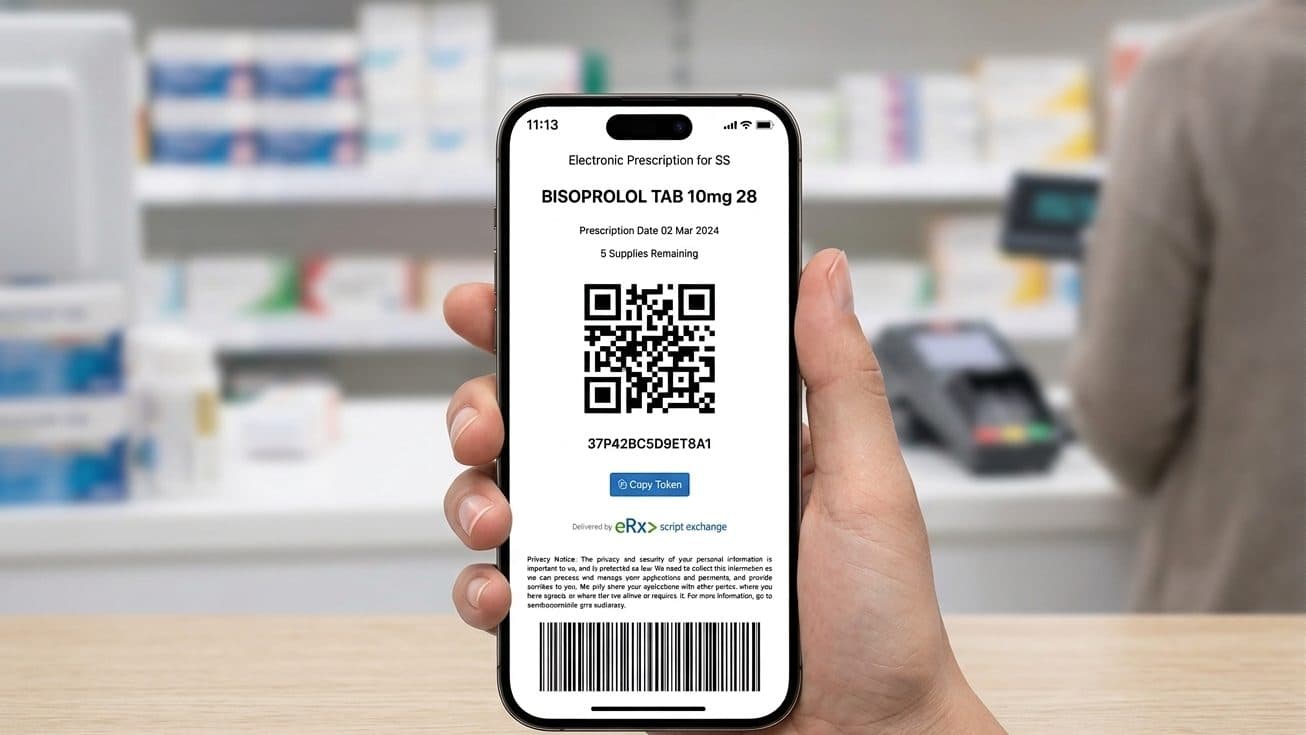
eScript. A secure digital prescription sent to you as an SMS or email. The message contains a QR-code token that any Australian pharmacy can scan. Most GPs now issue eScripts by default. They have the same legal force as paper and are easier to forward to a delivery pharmacy or family member. More in our eScripts guide.
Active Script List. A digital list of all your current prescriptions that one pharmacy is authorised to access. You set it up once through the Medicare app or with your pharmacist; from then on, you don't have to forward individual tokens. Useful if you fill most of your scripts at the same pharmacy. More in our Active Script List guide.
Hospital prescription. Issued by a hospital prescriber, often on discharge. May be on a hospital-specific form, electronic, or paper. Community pharmacies can dispense them, but check whether the hospital pharmacy has already supplied a starter quantity before you go.
Whichever format you receive, the pharmacist's dispensing process is the same. They verify the prescription, check the medicine against your record, dispense, label, and counsel you on use.
Who can write a prescription in Australia
Prescribing is restricted to registered health practitioners working within their scope. As of 2026 the main groups are:
- General practitioners (GPs) and other medical practitioners
- Specialists within their scope (a cardiologist for heart medicines, a psychiatrist for psychotropics, and so on)
- Dentists for medicines related to dental treatment
- Optometrists with prescribing endorsement for certain ocular medicines
- Nurse practitioners within their endorsed scope
- Midwives with prescribing endorsement for medicines used in maternity care
- Pharmacists in some states, for some conditions, under specific state programs
The pharmacist prescribing layer is new and varies sharply by state. In Queensland, Victoria, North Queensland, parts of New South Wales, and Western Australia, qualified community pharmacists can prescribe for a defined list of conditions, typically including uncomplicated urinary tract infections and hormonal contraception resupply. The exact list and the participating sites differ. The state-by-state detail belongs in our state cluster articles; this pillar simply notes that pharmacist prescribing is real, regulated, and limited.
A prescription written outside the prescriber's scope is not valid. A vet cannot write you a prescription. A pharmacy assistant cannot. Allied health practitioners generally cannot prescribe, with a small number of endorsed exceptions for specific professions (such as endorsed podiatrists and endorsed optometrists).
PBS versus private
What you pay at the counter depends on whether the medicine is listed on the Pharmaceutical Benefits Scheme (PBS). The PBS subsidises more than 900 medicines for Australian residents.
PBS-listed. The federal government pays most of the cost. You pay a capped co-payment: $25.00 per script for general patients, $7.70 for concession card holders in 2026. The list is at pbs.gov.au.
Private prescription. The medicine is not on the PBS, or you don't qualify for the PBS rate. You pay the full price the pharmacy sets, which varies between pharmacies. Private scripts are common for some newer medicines, some weight-loss medicines, certain hormonal preparations, and any medicine prescribed off-label or outside its PBS criteria.
Below co-payment. Some generics now cost less than the $25 general co-payment. You pay the actual price, not the co-payment.
The deep walkthrough of which scripts cost what, and why the same prescription can cost different amounts at different pharmacies, sits in our PBS pillar and in our private versus PBS guide.
The 60-day prescription reform
From September 2023, the federal government allowed eligible PBS medicines to be prescribed in 60-day quantities (two months of supply per dispense) instead of the historical 30-day standard. The reform was rolled out in tranches and the eligible-medicines list keeps expanding.
The intent is straightforward: fewer trips to the pharmacy, half the co-payments over a year for stable chronic-disease patients. Your GP decides whether to write the script as a 60-day quantity based on whether your condition is stable and your medicine is on the eligible list.
You don't apply for 60-day scripts. Your GP issues them where appropriate. If you're on a long-term medicine and still filling monthly, ask whether your medicine is now 60-day eligible. The full eligible list and the rollout dates are at health.gov.au and pbs.gov.au.
More in our 60-day prescriptions guide.
Repeats: how they work
A prescription can include repeats, which are additional supplies authorised by the same script. Most chronic-disease prescriptions are written with 5 repeats, giving you six fills in total from one prescriber visit. Some medicines (most Schedule 8 drugs, some short-course antibiotics) are written with no repeats.
Each repeat is dispensed only after the previous fill has been used or near-used. The pharmacist judges this based on the safety period for the medicine. You can ask for an early repeat if you're going overseas or have lost the previous supply, but the pharmacist may decline if the request is outside policy for the specific medicine.
For paper prescriptions, the pharmacist keeps the original for the repeats and gives you a "repeat authorisation" slip you bring back next time. For eScripts, the system regenerates a new token after each fill and sends it to your phone or email automatically.
The full mechanics, including how repeats interact with the Safety Net, are in our repeats guide.
eScripts and the token model
The eScript is now the dominant format. After your GP issues the prescription, you receive a token by SMS or email. The token is a unique reference (usually a QR code with an alphanumeric key) that any Australian pharmacy can scan to access the prescription record.
Three things to know:
- The token can only be sent to you. Your GP cannot send it directly to a pharmacy. You choose which pharmacy fills it.
- One token equals one fill. Once dispensed, the original token is consumed. If repeats remain, the system generates a new token automatically.
- You can show the token at the counter, forward the SMS or email to the pharmacy, or use a pharmacy app to store and order it.
For family members or carers picking up your medication, forward the SMS to their phone. They show it at the counter and the medicine is dispensed. For Schedule 8 medicines and some Schedule 4 medicines the pharmacist may verify identity, which is normal.
For the full mechanics, including how the QR code works, what to do if you delete the message, and what happens with delivery pharmacies, see our eScripts guide.
If something has gone wrong with a specific token (won't scan, expired, sent to the wrong number), our eScript troubleshooting guide walks through every common fix.
The Active Script List as an alternative
The Active Script List (ASL) is the opt-in alternative to managing tokens one by one. You give a single pharmacy permission to access your full list of current eScripts. That pharmacy can pull any of your scripts directly without you forwarding individual tokens.
Set up through:
- The Medicare app under "My Health Record"
- Your pharmacist, who can register you on the spot
- Directly with Services Australia
You can change which pharmacy holds your ASL at any time. ASL works best for people who fill most of their prescriptions at the same pharmacy and don't want to manage tokens. If you split your prescriptions across pharmacies, the token model is usually less hassle.
More in our Active Script List guide.
Continued dispensing for emergencies
If you run out of regular medication and cannot reach your prescriber, the Continued Dispensing arrangement allows a community pharmacist to dispense a standard quantity of certain medicines without a current prescription. It exists to bridge the gap when your script has lapsed or when you've lost your supply on a public holiday.
The arrangement covers a defined list of medicines: most cholesterol medicines, most blood-pressure medicines, the standard combined oral contraceptive pill, and several others. It does not cover Schedule 8 drugs, most antibiotics, or any new medicine you haven't been stably taking before. The pharmacist must verify the previous supply through your dispensing record or pharmacy notes.
You can use Continued Dispensing once per medicine in any 12-month period. After that, you need to see your prescriber and get a fresh script.
More in our continued dispensing guide.
What to do if you lose a script
The recovery path depends on the format:
- Lost eScript SMS or email. Ask your GP to resend it. GPs can regenerate the token at no cost. Check your Medicare app under "Prescriptions". Call the pharmacy that filled the previous repeat: they may be able to dispense from their record.
- Lost paper script. Phone your GP and ask for a duplicate. Most GPs can reissue without a fresh appointment, sometimes for a fee.
- Lost paper script for a Schedule 8 medicine. Stricter rules. The GP must follow specific reporting procedures and may need to see you again.
- Lost dispensed medication. Speak to your pharmacy. They may be able to supply a replacement under Continued Dispensing if the medicine is eligible. Otherwise you need a fresh script.
There is no central national "lost prescription" recovery service for consumers. Your prescriber and your pharmacist are your two paths.
The full troubleshooting walkthrough is in our eScript troubleshooting guide.
Foreign prescriptions in Australia
A prescription issued outside Australia cannot be dispensed at an Australian pharmacy. The Therapeutic Goods Administration and state pharmacy authorities require a current Australian prescription written by an Australian-registered prescriber.
Your options if you arrive in Australia with a foreign prescription:
- See an Australian GP. Bring the foreign prescription, your medical records, and any current packaging. The GP assesses whether the same medicine is available in Australia and issues a fresh local script.
- Bring a personal supply. Travellers can bring a three-month personal supply of most prescription medicines into Australia, provided the medicine is for their own use and a doctor's letter or original packaging is available. Schedule 8 medicines have stricter rules. Check the TGA Travelling with medicines guidance before you fly.
- Telehealth from your home country. Will not work. The pharmacy still cannot dispense from a foreign prescription, regardless of who wrote it.
Some medicines available overseas are not available in Australia, or are available under a different name or strength. Your Australian GP will substitute where appropriate or refer to a specialist if the exact medicine isn't accessible locally.
Costs
What you pay at the counter is set by three things: the medicine, the PBS status, and your concession status.
The headline 2026 numbers:
- General PBS co-payment: $25.00 per script
- Concessional co-payment: $7.70 per script
- General Safety Net threshold: $1,748.20 per family per calendar year
- Concessional Safety Net threshold: $277.20 per family per calendar year
Once you cross the Safety Net threshold, your medicines drop to the concessional rate (for general patients) or become free (for concession card holders) for the rest of the calendar year. The threshold resets on 1 January.
Private prescriptions sit outside the PBS pricing rules and vary between pharmacies. Shopping around is worthwhile for private scripts. Brand-premium charges, where you've chosen a brand more expensive than the cheapest available, also vary.
The full walkthrough of PBS pricing, concessions, the Safety Net, brand premiums, and why the same script can cost different amounts at different pharmacies sits in our PBS pillar.
Talk to someone now
Free advice for questions about a medicine, dose, or interaction.
Frequently asked questions
Twelve months from the date the prescriber signs it, for most medicines. Schedule 8 prescriptions are valid for six months. After expiry the script cannot be dispensed and you need to see your prescriber for a fresh one.