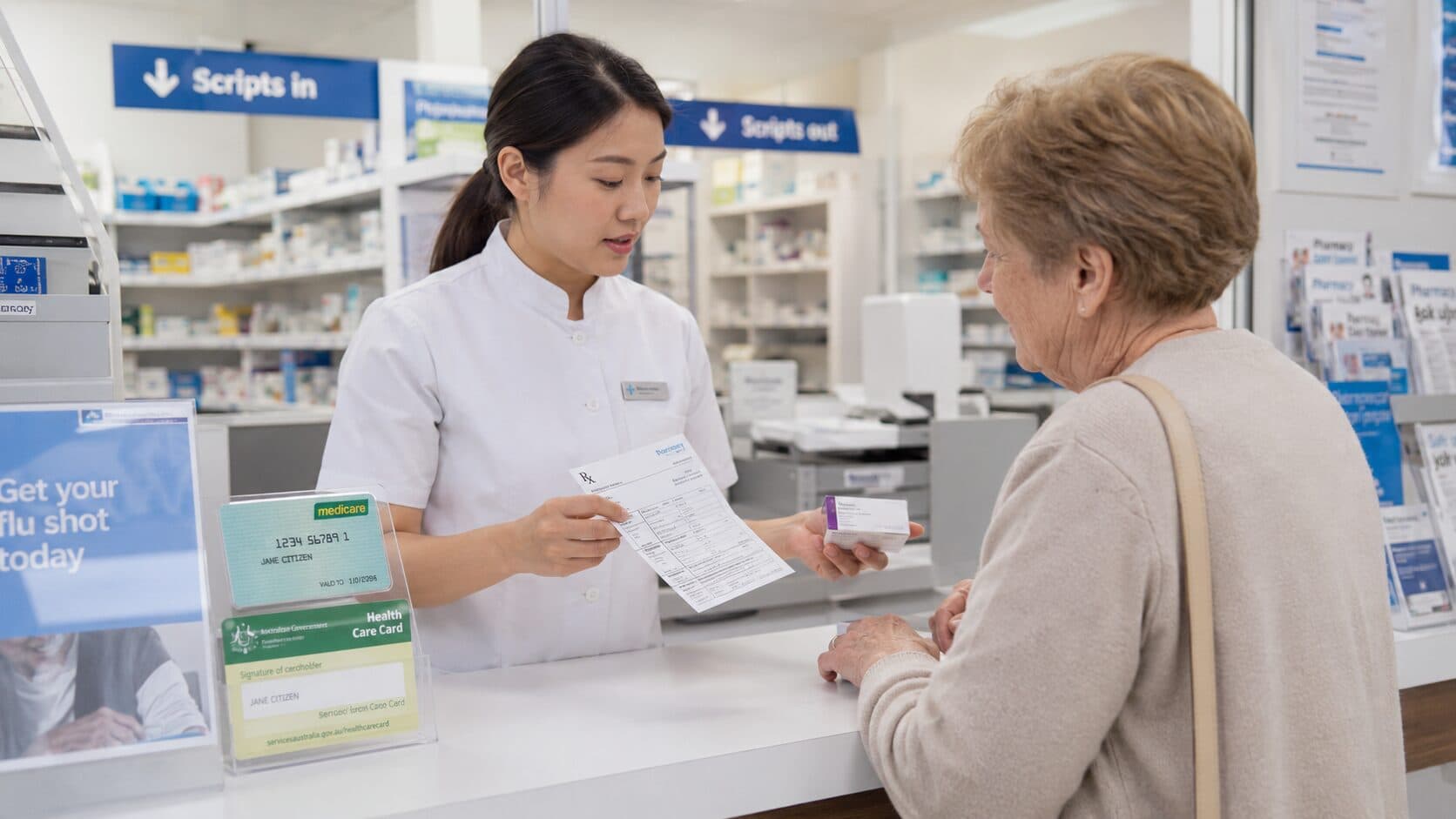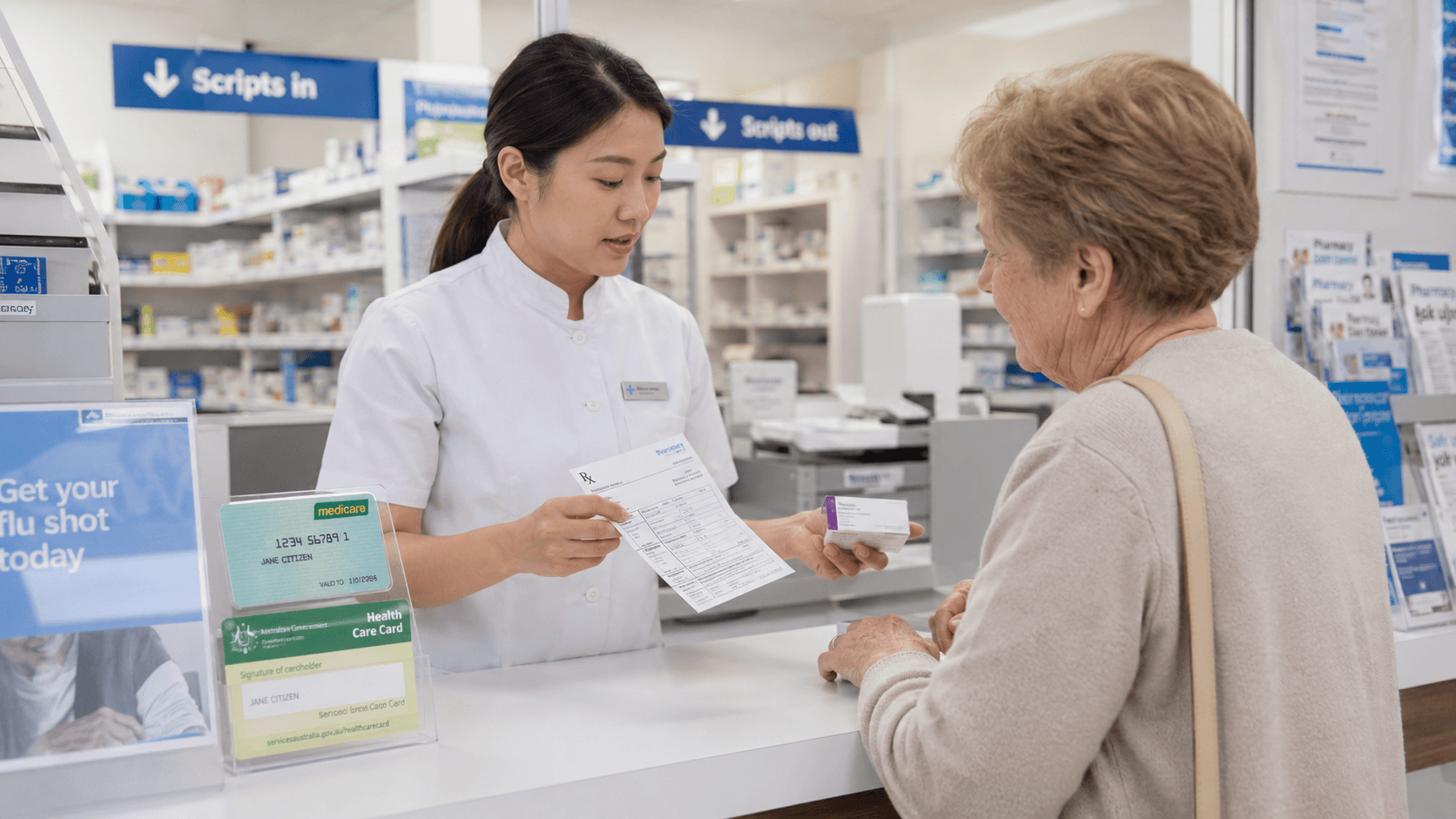
Every time you fill a prescription in Australia, three factors decide what you hand over at the counter: whether the medicine is on the Pharmaceutical Benefits Scheme, whether you hold a concession card, and how much your household has already spent on medicines this year. The same medicine that costs the full co-payment in January can cost far less, or need no co-payment at all, once your household passes the Safety Net threshold later in the year.
General information, not medical advice
This guide explains how things work in general. It cannot tell you what is right for you, so check anything that affects you with your pharmacist or GP.
Always read the label and follow the directions for use.
Based on official Australian government and health sources. Rules can change.
The Pharmaceutical Benefits Scheme (PBS) is the federal program that subsidises most prescription medicines, so you pay a capped co-payment while the government pays the rest (What are the current patient fees and charges, PBS). This guide sets out the 2026 amounts, who qualifies for the lower rate, and how the Safety Net reduces your costs once your yearly spending is high enough.
What the PBS is, and why it caps your costs
The PBS caps what you pay for most prescription medicines. The Australian Government pays most of the cost of a listed medicine and you pay a fixed co-payment, which is why a script that would otherwise run to hundreds of dollars costs a set amount at the counter (What are the current patient fees and charges, PBS). Many PBS medicines cost far more than the co-payment; the subsidy is the difference.
If a medicine is not listed on the PBS, it is a private prescription and the pharmacy charges the full price that the manufacturer and pharmacy set. You can look up whether a medicine is listed at pbs.gov.au. Our prescriptions in Australia guide covers how scripts work from end to end, and our PBS explained guide goes deeper on how listing and subsidy work.
What you pay per script in 2026
From 1st January 2026 a general patient pays up to $25.00 for most PBS medicines and a concession card holder pays $7.70 (What are the current patient fees and charges, PBS). That $25.00 cap is a reduction, down from $31.60 the year before (What are the current patient fees and charges, PBS). The concession rate of $7.70 is not indexed in 2026 and stays at that amount until 2029, then adjusts with inflation again from 1st January 2030, so concession holders keep the same price for several years (What are the current patient fees and charges, PBS).
Here is the gap between the two 2026 rates.
Source: 2026 co-payment amounts from current patient fees and charges, PBS.
If a medicine's price is lower than your co-payment, you pay the lower actual price rather than the full cap. The PBS says a pharmacist may add small allowable fees, but they cannot push the total above the co-payment (What are the current patient fees and charges, PBS). Pharmacists can also choose to discount an eligible general script priced between $25.00 and $51.10, though the PBS states that is at the pharmacist's discretion rather than a guarantee (What are the current patient fees and charges, PBS).
Which concession cards get the $7.70 rate
The lower $7.70 co-payment applies if you hold a valid concession or veteran card and show it when the script is dispensed. These are the main cards that qualify.
| Concession card | Issued by |
|---|---|
| Pensioner Concession Card | Services Australia |
| Health Care Card | Services Australia |
| Commonwealth Seniors Health Card | Services Australia |
| Veteran Gold Card | Department of Veterans' Affairs (DVA) |
concessional co-payment eligibility, current patient fees and charges, PBS. Card eligibility itself is set by Services Australia and the Department of Veterans' Affairs.
Show the card at every fill and the pharmacy applies the concessional rate at the counter, with no separate paperwork. If you were eligible but did not show the card, Services Australia says you can claim the difference back through its patient refund process, so long as you ask the pharmacist for an official receipt, which is not a regular sales receipt (Getting a refund when you don't have your cards, Services Australia). Our concession card pharmacy savings guide covers who qualifies in more detail.
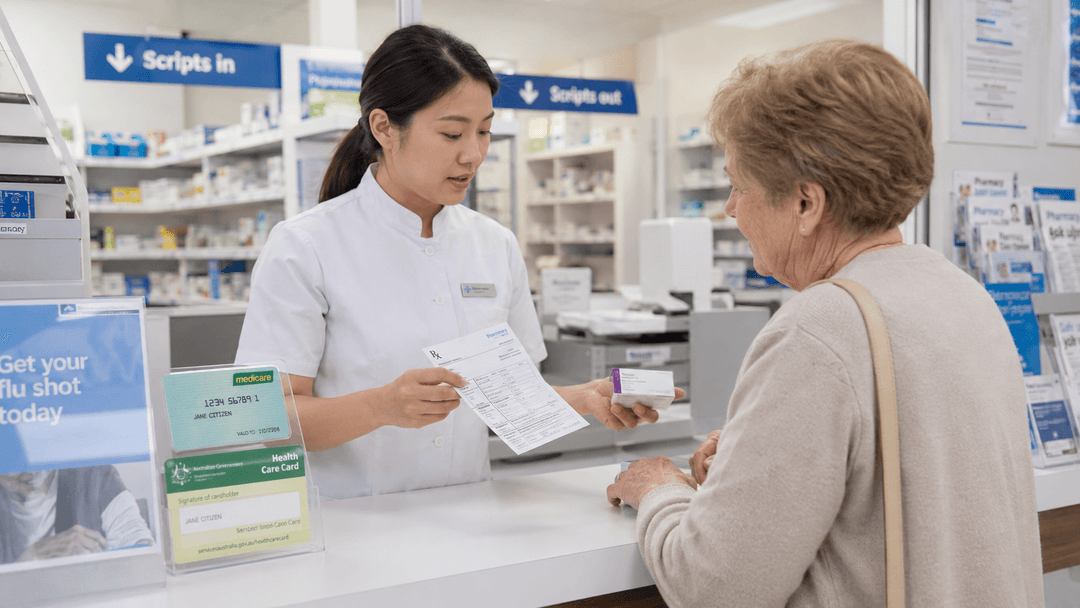
Hand it over at every fill and the pharmacy applies the $7.70 rate immediately, so there is no form to lodge and nothing to claim back later.
How the PBS Safety Net lowers your costs mid-year
The PBS Safety Net caps what one household spends on medicines across a calendar year, so your scripts cost less, or need no co-payment, once you have spent enough. When your family's eligible PBS spending reaches the threshold, general patients drop to the concession rate for the rest of the year and concession holders pay no further co-payment, although any brand or therapeutic group premium still applies (What are the current patient fees and charges, PBS).
Across a calendar year the Safety Net moves through four stages.
Source: 2026 Safety Net figures from current patient fees and charges, PBS.
For 2026 the general threshold is $1,748.20 and the concession threshold is $277.20, each measured per family unit across the calendar year (What are the current patient fees and charges, PBS). The table below shows what changes once you pass it.
| Patient type | Per-script co-pay | Safety Net threshold | After the threshold |
|---|---|---|---|
| General | $25.00 | $1,748.20 | $7.70 each |
| Concession | $7.70 | $277.20 | No co-payment (premiums still apply) |
2026 PBS Safety Net figures, current patient fees and charges, PBS. Amounts are per family per calendar year.
The count runs to 31st December and starts fresh on 1st January, so the Safety Net does not carry into the next year.
For the Safety Net, a family unit can be an individual, a couple, or parents with dependent children, and everyone's eligible PBS spending counts towards the same total. The PBS says a couple can be married or de facto, of the same or opposite sex (current patient fees and charges, PBS).
What counts towards the Safety Net, and what does not
Most PBS scripts count towards your Safety Net total, though a few costs do not. What counts is the co-payment you pay on each PBS medicine, plus the Safety Net recording fee charged on medicines priced below the co-payment (What are the current patient fees and charges, PBS).
What does not count towards the threshold:
- The brand premium you pay for choosing a more expensive brand when a cheaper equivalent exists
- Private prescriptions that are not PBS-listed
- Over-the-counter medicines you buy without a prescription, like most paracetamol
- The therapeutic group premium on certain medicines, and any special patient contribution
- Early supply of some medicines, for example a supply of the same medicine within 20 days of the last one (50 days for a 60-day prescription) under the PBS early supply rule (PBS explanatory notes on patient charges)
If you are unsure whether a medicine counts, the pharmacist can tell you before dispensing, or you can check your running total on your record form.
How to track your spending across pharmacies
Scripts filled at different pharmacies all count towards the same Safety Net total, but the tally is not added up automatically across pharmacies. To claim the Safety Net you keep the record yourself, and Services Australia sets out two main ways to do it (Keep track of your PBS medicines, Services Australia).
The first is the Prescription Record Form. To use the Safety Net you keep a record of your PBS medicine spending on a Prescription Record Form, which pharmacies can hold and update each time they dispense for you (What are the current patient fees and charges, PBS). If your family fills scripts at more than one pharmacy, ask each to record the fills, or download the form and ask a pharmacist to add recent scripts (Safety Net record form and card application PB240, Services Australia).
The second works if you use one pharmacy for everything. Services Australia says a single pharmacy can keep a computer record of your PBS spending and let you know when you are close to the threshold (Keep track of your PBS medicines, Services Australia). Our Safety Net card application guide walks through both routes.
How to get your Safety Net card
Once your family passes the threshold, the pharmacy that dispenses the script that takes you past it can issue your Safety Net card there and then, so you do not apply separately (What are the current patient fees and charges, PBS). You then show the card at every fill for the rest of the year.
If the threshold was passed but no card was issued, for example because your fills were split across pharmacies, a pharmacist can issue the card once your PB240 record form or pharmacy printouts show you have reached the threshold (PBS Safety Net card application, Services Australia). If you paid more than you needed to after reaching the threshold, Services Australia says you can claim a refund with the Patient claim for refund form (PB132), attaching receipts and record forms signed by the pharmacist (Patient claim for refund PBS form, Services Australia).
Extra help for Aboriginal and Torres Strait Islander people
Aboriginal and Torres Strait Islander people can get PBS medicines even cheaper through the Closing the Gap (CTG) PBS Co-payment Program. The Australian Government advises that an eligible person who normally pays the general rate instead pays the concession rate of $7.70, and an eligible person who already holds a concession card pays no co-payment for their PBS medicines, although any brand premium still applies (Closing the Gap PBS Co-payment Program, PBS).
A PBS prescriber or an eligible Aboriginal Health Practitioner registers you once, and after that the lower price applies to your eligible PBS scripts (Closing the Gap PBS Co-payment Program, PBS). The program covers medicines listed on the PBS and does not extend to over-the-counter or non-PBS medicines.
Why the same script can cost different amounts at different pharmacies
Most people pay no more than $25.00 or $7.70 at any pharmacy, but the amount can still vary: a pharmacy may take up to $0.60 off the concession co-payment, or choose to discount an eligible general script priced between $25.00 and $51.10. Other differences arise in three cases: a brand premium on a more expensive brand, a private price the pharmacy sets on a non-PBS medicine, or a medicine priced below the co-payment, where the real price can vary and a pharmacist may discount (What are the current patient fees and charges, PBS). Our script cost comparison guide shows how to compare safely, and our private versus PBS guide explains the private side.
Talk to someone now
Free advice for questions about a medicine, dose, or interaction.
Frequently asked questions
A family reaches it after $1,748.20 of eligible PBS spending, or $277.20 for concession card holders (a family that mixes concession and general patients can choose which threshold to use). Beyond that point, general patients are charged the $7.70 concession rate and concession holders pay no further co-payment until the year ends, although premiums still apply.
No. Each calendar year is counted on its own, so the card stops applying on 1st January and your spending starts again from zero. For anyone on regular medicines, a fresh record form from the first fill of the new year makes the next threshold easier to reach.
Per family unit, which is why households on several medicines reach the threshold faster than one person filling the odd script. Partners and dependent children are pooled into one running total rather than each tracked separately.
Usually not. Most paracetamol is bought over the counter without a prescription, and only PBS-listed medicines dispensed on a prescription add to your total. Some paracetamol products are PBS-listed, and those count when dispensed on a PBS prescription.
Usually yes. As long as the pharmacy gave you an official receipt, the gap between the general and concession price can be refunded, so it is worth asking rather than writing off the extra you paid. Carrying the card next time avoids the paperwork altogether.
Because the maximum a general patient pays for a PBS script was cut at the start of the year, so anyone paying the full cap now pays less per medicine. Concession card holders saw no change, as their rate was already at the lower level and stayed there. Find a pharmacy near you: browse Australian pharmacies.