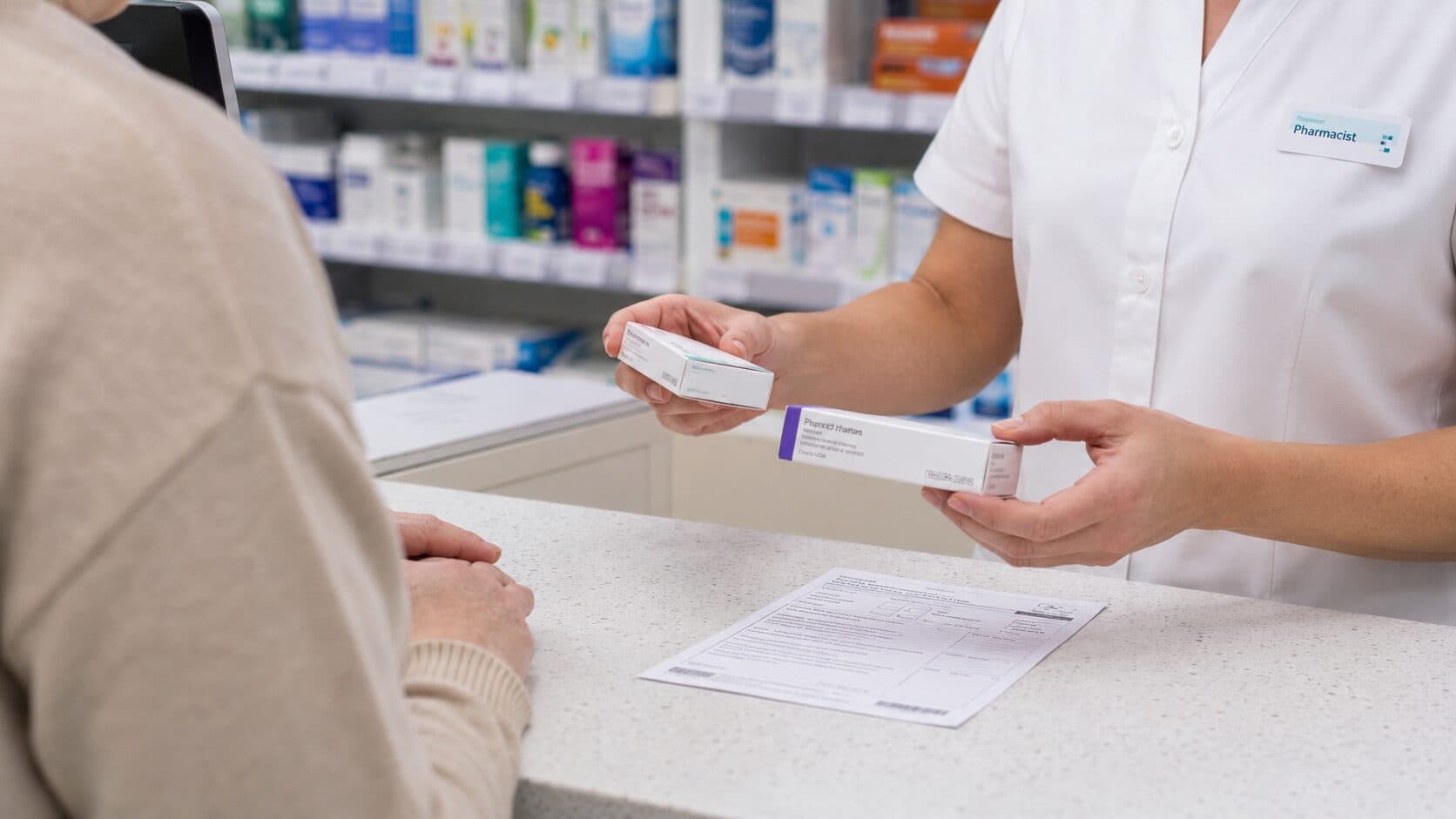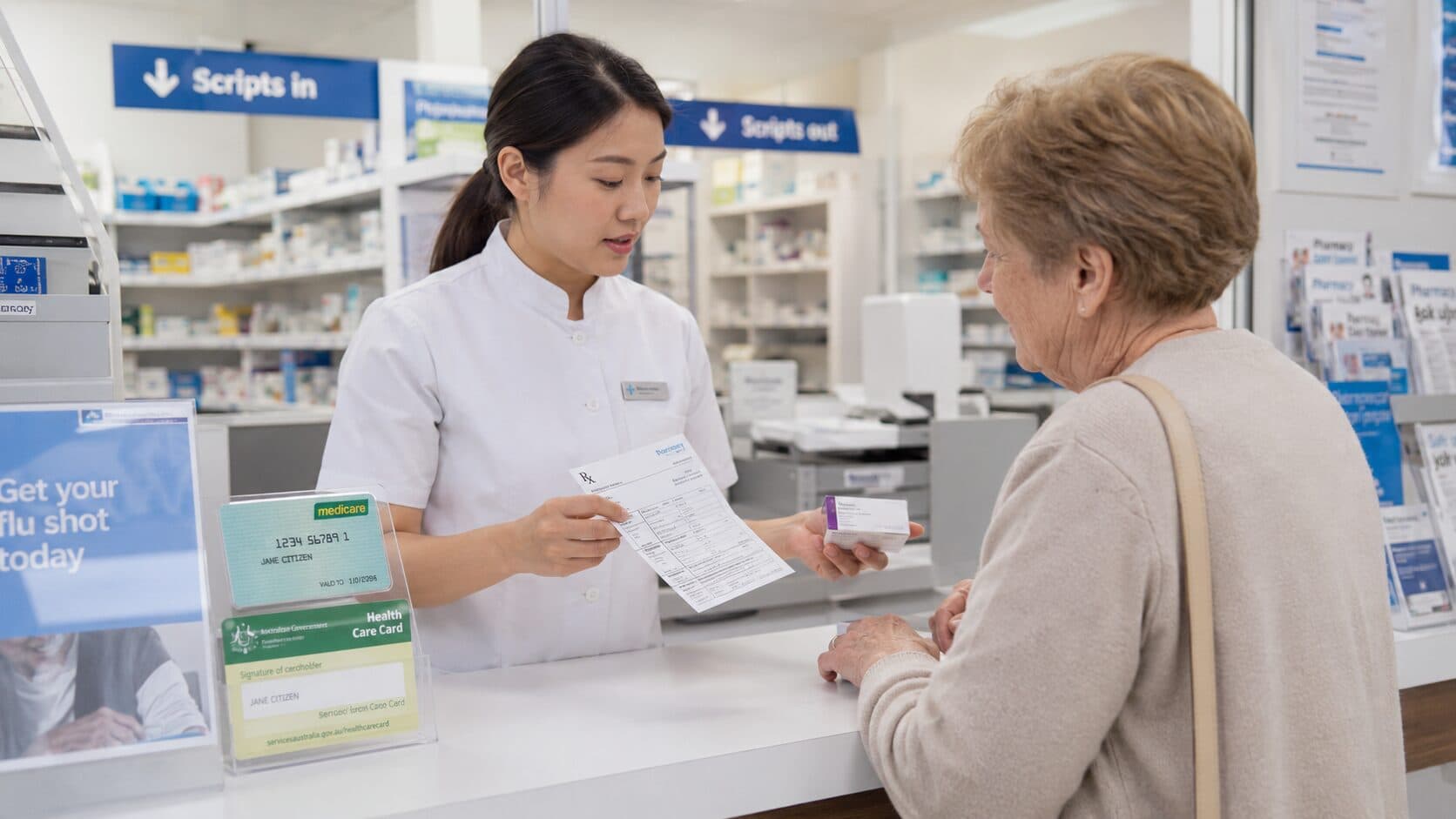
An eligible concession card reduces the maximum price of a Pharmaceutical Benefits Scheme (PBS) prescription from $25.00 to $7.70 in 2026. It also gives your family a much lower PBS Safety Net threshold, after which eligible PBS medicines are supplied without a co-payment for the rest of the calendar year (current patient fees and charges, PBS).
General information, not medical advice
This guide explains how things work in general. It cannot tell you what is right for you, so check anything that affects you with your pharmacist or GP.
Always read the label and follow the directions for use.
Based on official Australian government and health sources. Rules can change.
This guide explains which cards qualify, how the saving is applied at the pharmacy and what to do if you forgot to show your card. For how the scheme sets its prices, start with our guide to the PBS.
Cards that qualify for the concession rate
Services Australia issues most of these cards and the Department of Veterans' Affairs issues veteran cards. They decide who qualifies, not your pharmacy. Any of the following lets you claim the concession co-payment when a script is dispensed.
Source: Concession and health care cards, Services Australia and, for veteran cards, the PBS explanatory notes.
The Health Care Card covers people on payments like JobSeeker Payment, Parenting Payment partnered and the maximum rate of Family Tax Benefit Part A, while the Commonwealth Seniors Health Card is for self-funded retirees over Age Pension age who meet an income test but are not on a pension. A Pensioner Concession Card and a Commonwealth Seniors Health Card each last two years, while a Health Care Card is valid for one year, and a Low Income Health Care Card has to be renewed each year (Services Australia). Whichever card you hold, the pharmacy applies the concession rate once it has your card details.
The pharmacy can only apply the concession rate once it sees a current card, so carry the plastic one or the digital card in the myGov or Express Plus Centrelink app each time you collect a script.
How much does a concession card save per script?
The gap between the two co-payments is set for 2026, and it widens into a real saving over a year.
| Concession card holder | General patient | |
|---|---|---|
| Co-payment per PBS script | $7.70 | Up to $25.00 |
| Safety Net threshold (2026) | $277.20 | $1,748.20 |
| Cost after the threshold | No co-payment (brand premiums still apply) | Up to $7.70 |
2026 figures from current patient fees and charges, PBS and PBS Safety Net thresholds, Services Australia. The co-payment is a ceiling, and any brand premium is added on top. A pharmacy may also choose to discount a general script for a medicine priced between $25.00 and $51.10.
The Australian Government reduced the general co-payment to $25.00 on 1st January 2026 and is holding the concession rate at $7.70 until the end of 2029, so these figures apply for several years rather than one (Pharmaceutical Benefits Scheme).
Some medicines are priced below $7.70. When that happens you pay the lower price rather than the full co-payment, and a pharmacy may also reduce the concession rate by up to 60 cents, though it does not have to (Pharmaceutical Benefits Scheme). The PBS says prices can differ between pharmacies and that comparing them can be worthwhile; our guide on why script costs vary between pharmacies explains the range.
What the concession rate saves over a year
The saving is easiest to see across a full year. Applying the $17.30 difference to one, two or three scripts a month, before any Safety Net, gives a rough guide, assuming each medicine would cost a general patient the full $25.00.
| Scripts per month | Yearly saving with a concession card |
|---|---|
| 1 | $207.60 |
| 2 | $415.20 |
| 3 | $622.80 |
calculated from the 2026 PBS co-payments, applying the $17.30 gap across 12, 24 and 36 scripts.
For a couple who both take regular medicines, the household saving is higher again, and the Safety Net below lowers the cost further as the year's spending grows.
The Safety Net starts earlier for concession holders
The PBS Safety Net works across a calendar year and resets on 1st January. Once your household's PBS spending passes the threshold, medicines cost less for the rest of the year. The PBS applies one threshold to a family unit, so a partner's and dependent children's scripts add to the same total (Pharmaceutical Benefits Scheme).
For 2026 the concession threshold is $277.20, well under the $1,748.20 general threshold (Services Australia). At $7.70 a script, a concession holder reaches it after roughly 36 scripts in a year.
Once the threshold is reached, the PBS says concession card holders pay no co-payment for their PBS medicines for the rest of the calendar year, although any premium still applies, while general patients then pay the $7.70 concession rate (Pharmaceutical Benefits Scheme). You need a PBS Safety Net card to claim it. Your spending is recorded on a Safety Net prescription record form (PB240) that you keep and hand to the pharmacist each time, or on printouts from your pharmacy, and the pharmacist issues the card once you reach the threshold (PBS Safety Net card application, Services Australia). Our guide to applying for a Safety Net card sets out the steps, and the concession Safety Net guide covers how the lower threshold works in more detail.
The Closing the Gap co-payment program for First Nations people
Aboriginal and Torres Strait Islander people can access a separate saving through the Closing the Gap PBS Co-payment Program, usually shortened to CTG (Pharmaceutical Benefits Scheme). The program is open to First Nations people of any age who have a Medicare card, where a prescriber or Aboriginal Health Practitioner judges that the person would experience setbacks in preventing or managing a condition without their prescribed PBS medicine, and would be unlikely to keep taking it without help from the program.
The PBS describes the saving in two steps (Pharmaceutical Benefits Scheme):
- someone who would normally pay the general co-payment pays the concession rate instead
- someone who already holds a concession card pays no co-payment for their PBS medicines, although any brand premium still applies
Registration is a one-off step handled by a prescriber or Aboriginal Health Practitioner, not something you apply for yourself, and the script has to be dispensed by an approved supplier like a community pharmacy (Pharmaceutical Benefits Scheme).
How the pharmacy applies your concession rate
Your physical or digital card is the proof you need. The pharmacy reads your card details into its dispensing system, which applies the $7.70 rate immediately. The PBS requires a concession number on every concessional PBS prescription, which is why the pharmacy needs your current card details (PBS explanatory notes on patient charges).
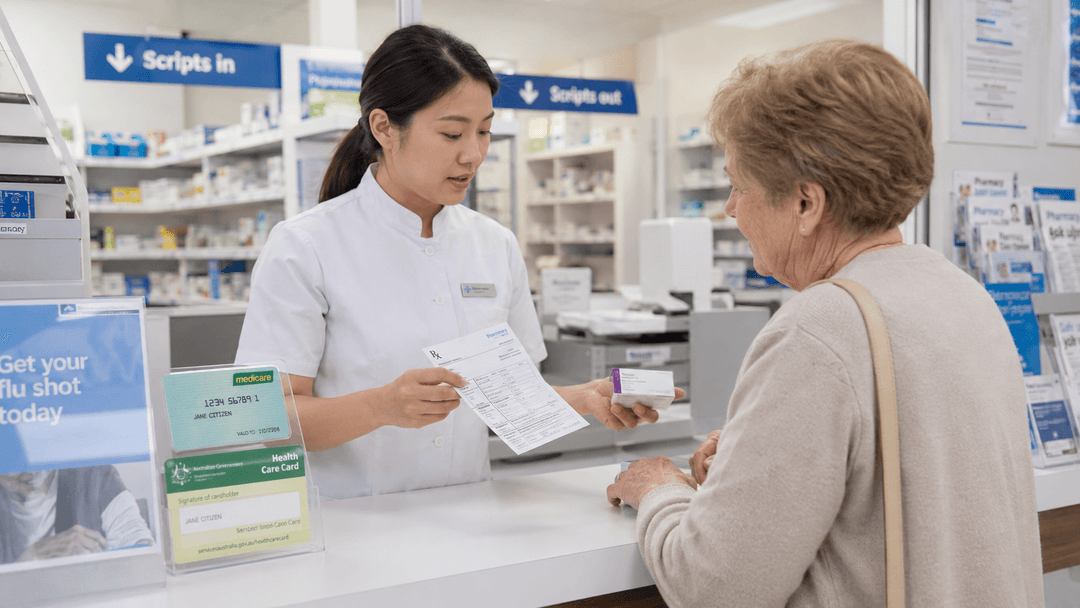
Once the pharmacy has your current card, its dispensing system applies the $7.70 concession rate immediately, whether you show the plastic card or the digital one in the myGov or Express Plus Centrelink app.
A few points are worth knowing:
- The card has to be current. If you cannot show the pharmacist a current entitlement, you are charged the general price (PBS Safety Net explanatory notes).
- The name on the script must match the cardholder. A child's script is claimed against the card of the parent the child is listed with, since dependent children appear on the card (Services Australia).
- If you leave the card at home, the pharmacy may charge the general price. Services Australia advises asking the pharmacist for an official receipt (not a regular sales receipt), which lets you claim the difference with the Patient claim for refund form, although you may not get a full refund for some brand-name medicines (Getting a refund when you do not have your cards, Services Australia).
Veterans' cards also connect to the Repatriation Pharmaceutical Benefits Scheme (RPBS), which the Department of Veterans' Affairs administers for eligible veterans. Our DVA pharmacy guide sets out those entitlements.
When your concession status changes
Concession status is not fixed. Retirement, returning to work, a change in a partner's income or a child reaching a certain age can all change which card you hold, or whether you hold one at all.
- If your card expires or is cancelled, you pay the general co-payment of up to $25.00 from your next script (Pharmaceutical Benefits Scheme). The pharmacy updates its record once you tell it at your next visit.
- If you become newly eligible, showing the new card means you pay the concession rate from that day onward.
- If you remain eligible, Services Australia sends a new Pensioner Concession Card or Commonwealth Seniors Health Card 4 to 6 weeks before the current one expires, while a Low Income Health Care Card has to be renewed each year (Services Australia).
Talk to someone now
Free advice for questions about a medicine, dose, or interaction.
Frequently asked questions
$7.70 at most, plus any brand premium. According to the PBS, the maximum concession co-payment is set to remain at $7.70 through 2029 (What are the current patient fees and charges?, Pharmaceutical Benefits Scheme).
The Pensioner Concession Card, the Health Care Card including the Low Income Health Care Card, the Commonwealth Seniors Health Card and Department of Veterans' Affairs Gold and Orange cards all qualify, and a White card qualifies only for RPBS prescriptions unless the holder also has a Centrelink concession card. Services Australia or the Department of Veterans' Affairs issues them, not the pharmacy (Concession and health care cards, Services Australia).
The concession threshold is a small fraction of the general one, so a concession household stops paying co-payments far sooner in the year, although brand premiums still apply. Because a household's scripts count under one shared threshold, a family often reaches that point faster still (What are the current patient fees and charges?, Pharmaceutical Benefits Scheme).
Yes. Eligible First Nations patients register once for the Closing the Gap program through their prescriber or an Aboriginal Health Practitioner, with no separate form to lodge themselves. After registering, a patient who would otherwise pay the general price is charged the concession rate, and a concession card holder pays no co-payment, although any brand premium still applies (Closing the Gap (CTG) PBS Co-payment Program, Pharmaceutical Benefits Scheme).
Your medicines revert to the general price until you have a current card again. Services Australia sends a new Health Care Card when the current one expires if you are still eligible, but a Low Income Health Care Card has to be renewed each year, and renewing it before the expiry date printed on the card avoids that break (Concession and health care cards, Services Australia).
No. It only covers PBS-listed medicines. A private, non-PBS prescription is priced by the manufacturer and the pharmacy, so the cost varies from one pharmacy to another (What are the current patient fees and charges?, Pharmaceutical Benefits Scheme). Find a pharmacy near you: browse Australian pharmacies.