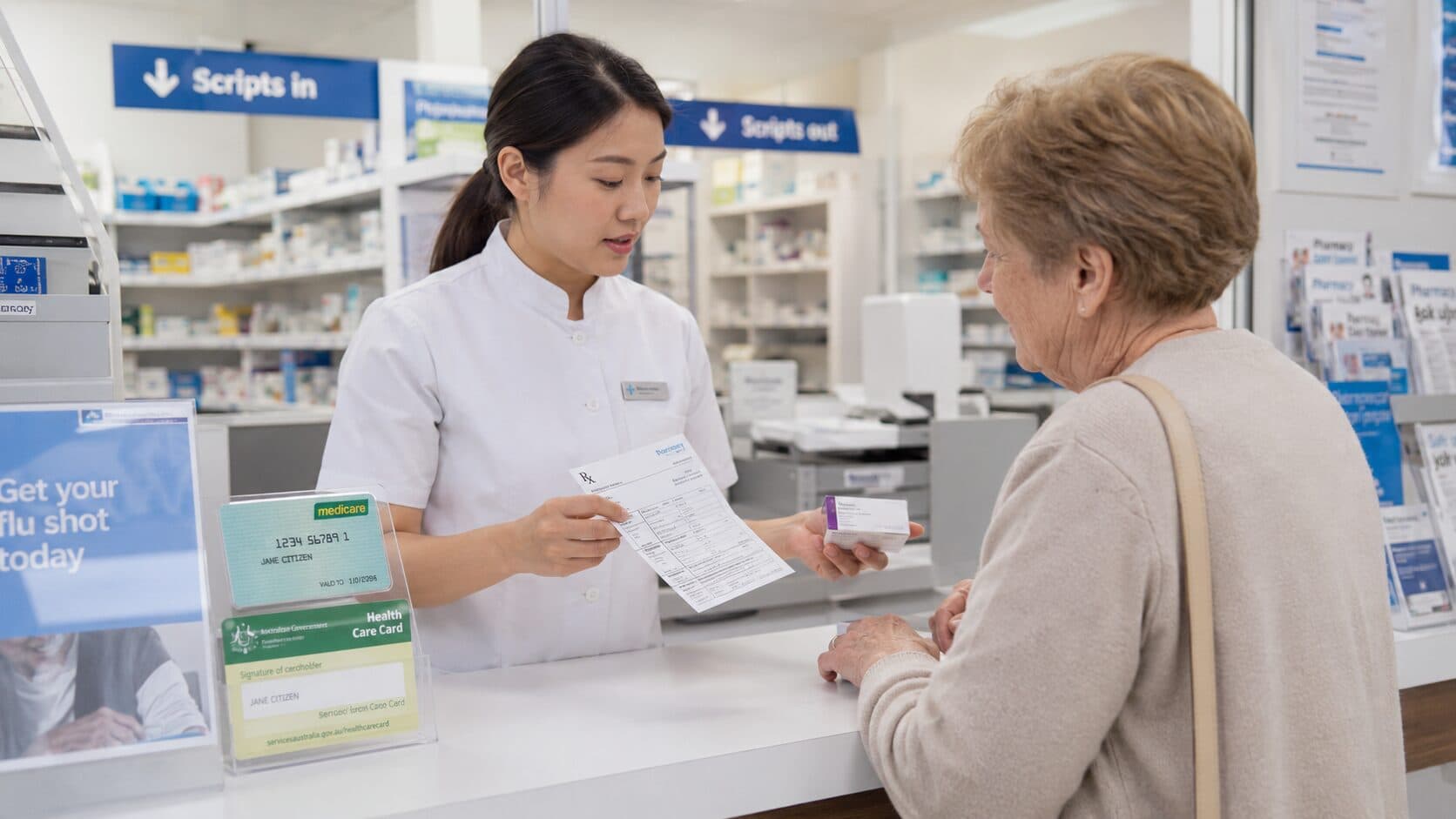
For most Australians, money spent at the pharmacy is no longer a tax deduction. The Net Medical Expenses Tax Offset, the old rebate that once covered out-of-pocket medical and pharmacy costs, closed to everyone after the 2018-19 income year, and nothing general has replaced it. Pharmacy receipts are still useful in a few specific places: private health "extras" cover, a National Disability Insurance Scheme (NDIS) plan, some salary-packaging arrangements, and tracking your spending towards the Pharmaceutical Benefits Scheme (PBS) Safety Net. It is general information, not tax advice; the Australian Taxation Office (ATO) or a registered tax agent can confirm what applies to you. For the spending-tracking angle, see our PBS Safety Net guide.
General information, not medical advice
This guide explains how things work in general. It cannot tell you what is right for you, so check anything that affects you with your pharmacist or GP.
Always read the label and follow the directions for use.
Based on official Australian government and health sources. Rules can change.
Pharmacy spending and your personal tax return
For personal spending, the short answer is no. The Net Medical Expenses Tax Offset (NMETO) was phased out over several years and was available for the last time in the 2018-19 income year; from 1st July 2019 no taxpayer can claim it, and there is no general medical-expense deduction in its place (Medical expenses tax offset, ATO). The ATO advises that medical expenses are private in nature and cannot be claimed as a deduction (Medical and dental expenses, ATO). A PBS co-payment, $7.70 concessional or $25 general in 2026, is therefore not something you deduct on your return; the subsidy is already built into the PBS price. Those co-payments are set by the government: the general amount is indexed each 1st January from 2027, and the concessional amount stays at $7.70 through 2029, so the current figure is on the PBS patient fees page.
Where a pharmacy receipt still counts
A receipt still matters in four situations. In three of them the money comes back from a third party rather than the ATO. If you hold private health insurance with a pharmacy benefit on your "extras" cover, the insurer reimburses part of your out-of-pocket cost, and it needs the receipt. If you have an NDIS plan that funds pharmacy items, the National Disability Insurance Agency (NDIA) pays against your plan budget. If you self-manage your plan, the NDIS asks you to keep receipts for five years so you can show how you paid for your supports (How to pay for your NDIS supports, NDIS). If your employer runs a salary-packaging arrangement that reimburses pharmacy costs, the receipt goes to the packaging administrator.
The fourth situation is different, because the benefit does come through the ATO. If you run a business, a workplace first-aid kit or business-supplied pharmacy items can be a deductible business expense in limited cases, claimed through your own tax return. A registered tax agent can advise whether a given cost qualifies.
If you cannot tell whether a receipt matters to your tax position, holding it for the year costs nothing, and a registered tax agent can tell you later. The ATO asks you to keep records for five years from the date you lodge your tax return (Records you need to keep, ATO).
How to get a year-end statement from your pharmacy
Your pharmacy can usually print a summary of the scripts you filled and the amount you paid, though you normally need to ask for it. The steps are simple.
A request as simple as this is usually enough: "Could I have a printed dispensing statement for last year's scripts, showing what I paid for each?" Larger pharmacies may take a day or two if you ask for several years at once.
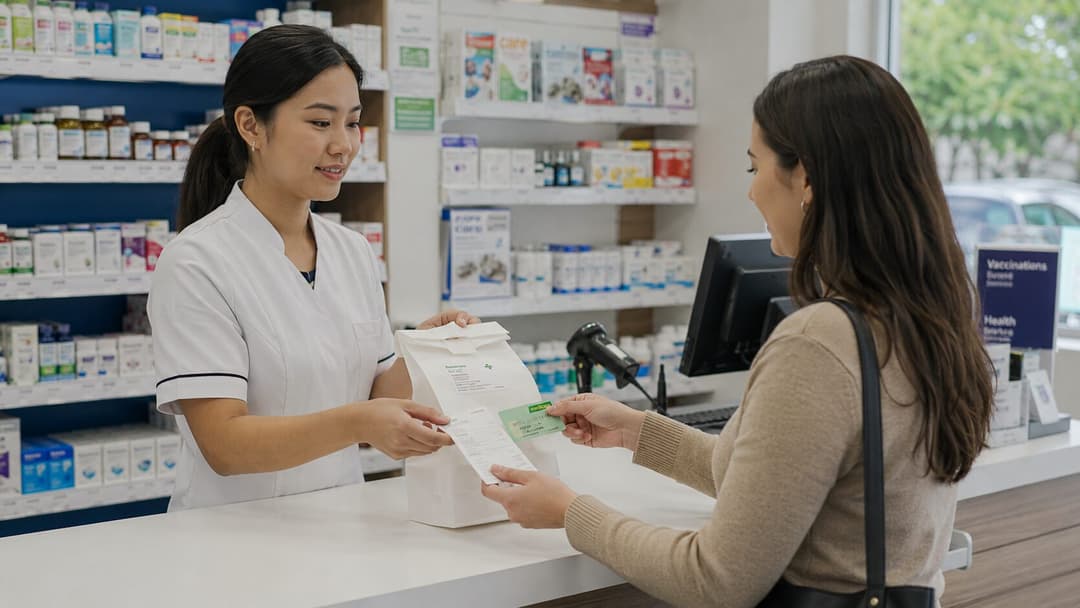
For anything you might claim through an insurer, an NDIS plan, or a business, it is worth keeping the pharmacy's own receipt that shows the item, the date, and the amount, rather than the eftpos slip, which shows only a total.
Private health "extras" and NDIS plans
People most often need their pharmacy receipts in these two situations. On a private health "extras" policy with a pharmacy benefit, the insurer may pay a benefit towards some prescription items. According to the privatehealth.gov.au glossary, it is common for pharmacy items to require a co-payment equal to the amount listed for the item on the PBS. Each insurer sets its own benefit limits and its own time limit for lodging a claim. Brand premiums and below-co-payment items may not be eligible, so the policy's product disclosure statement is worth reading before you assume something is covered.
On an NDIS plan, the pharmacy items a plan may fund include continence products and some assistive equipment. The NDIS does not fund medicines, whether prescribed or bought over the counter (Guide to reasonable and necessary decisions, NDIS). How the pharmacy is paid depends on how your plan is managed: for NDIA-managed funding the pharmacy submits the claim, a plan manager pays providers from plan-managed funding, and self-managing participants pay the pharmacy or claim from their plan themselves (How to pay for your NDIS supports, NDIS). If you are unsure whether an item is covered, your plan manager or support coordinator is the person to ask.
Talk to someone now
Free advice for questions about a medicine, dose, or interaction.
Frequently asked questions
For most personal taxpayers, no. The Net Medical Expenses Tax Offset ended in the 2018-19 income year and was not replaced, so a personal return has nowhere to claim everyday pharmacy costs in 2026. A few situations (an NDIS plan, private health insurance, salary packaging, a genuine business expense) still use pharmacy receipts, though only the business case runs through the ATO. If your circumstances are unusual, the ATO's guidance is the place to check.
No. A PBS co-payment ($25 general or $7.70 concessional in 2026) is the subsidised price you pay for the medicine, and the ATO advises that medical expenses are private in nature and cannot be claimed as a deduction (Medical and dental expenses, ATO). The medical expenses tax offset ended after the 2018-19 income year, so there is no offset either.
For personal use, no. The ATO advises that medical expenses are private in nature and cannot be claimed as a deduction (Medical and dental expenses, ATO), and the medical expenses tax offset ended after the 2018-19 income year. A receipt for a medicine may still help with a business expense, an insurance claim or a salary-packaging arrangement, but not with an NDIS plan, because the NDIS does not fund medicines.
You can ask the pharmacy for a printed dispensing statement for the year. If you are requesting it for someone other than yourself, you may need to bring photo identification.
For a private health insurance claim, your insurer sets the time limit, so it is worth checking your policy. The NDIS asks self-managing participants to keep receipts for five years (How to pay for your NDIS supports, NDIS). For a business expense, the ATO says most records need to be kept for five years from when you prepared or obtained them, or completed the transaction, whichever is later (Record-keeping rules for business, ATO).