
A dose administration aid (DAA) is a sealed, tamper-evident pack, often known as a Webster pack, that sorts your medicines into the day and time you are meant to take each one. The Pharmacy Programs Administrator, which runs the government-funded DAA program, describes it as a well-sealed device that organises medicine doses to the schedule your prescriber has set.
General information, not medical advice
This guide explains how things work in general. It cannot tell you what is right for you, so check anything that affects you with your pharmacist or GP.
Always read the label and follow the directions for use.
Based on official Australian government and health sources. Rules can change.
If you take several medicines and find them hard to keep track of, a pharmacy can pack them this way and be paid a service fee by a federal program. Whether you pay anything for the packing itself is up to the pharmacy, so it is worth asking before you start.
There is no online form and nothing to lodge with Services Australia. Your community pharmacist checks whether you meet the program's criteria and, if you do, sets up the service. This guide sets out those criteria and what a pack costs. For how a pack works day to day, see our Webster packs and DAA guide and our medication management guide.
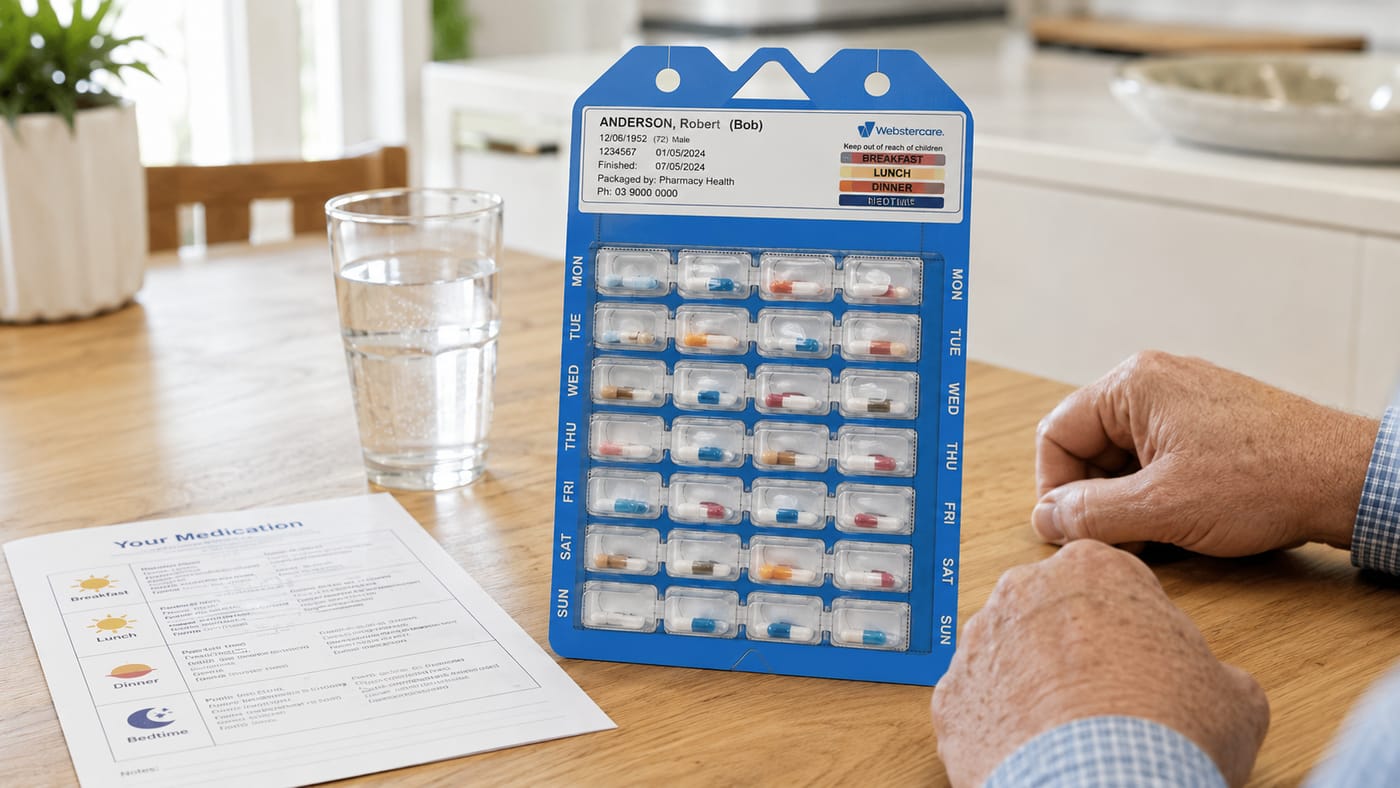
Each blister holds the medicines for a single time of day, so you can see at a glance whether a dose has already been taken.
How the dose administration aid program is funded
The DAA program is funded by the Australian Government through the Department of Health, Disability and Ageing and administered by the Pharmacy Programs Administrator (PPA). It sits within the Eighth Community Pharmacy Agreement, the funding deal between the government and community pharmacy that also pays for medication reviews and staged supply.
Under the program, a participating pharmacy is paid $6.17 for each weekly DAA service it provides to an eligible patient. Each pharmacy is also allocated its own weekly cap on the number of funded services it can claim, and the base cap has been 90 services a week since 1st July 2024. The DAA Program Rules also allow a pharmacy to add its own charge for the service at its discretion, whether or not it has reached that cap.
You must meet every eligibility rule
The PPA lists what you need before a pharmacy can provide a subsidised DAA, and you have to meet all of it, not just one part. The PPA says you must hold a Medicare card or a Department of Veterans' Affairs (DVA) card, or be someone eligible for a Medicare card; you must live at home in a community setting rather than in residential aged care; you must hold a current government-issued concession card; and you must either have difficulty managing your medicines because of a literacy or language barrier, a physical disability or a cognitive difficulty, or take five or more prescription medicines and have difficulty managing them.
Source: eligibility rules from Dose Administration Aids, Pharmacy Programs Administrator. You must meet all four.
The concession card is easy to overlook, because it does two jobs at once: it is one of the eligibility rules for the packing service, and it is also the card that lowers the price of the medicines inside the pack. The pharmacist is the one who confirms that a DAA suits you and sets up the service.
Which concession cards count
The PPA counts government-issued concession cards. A Pharmaceutical Benefits Scheme (PBS) Safety Net card is not an eligible concession card.
| Card | Counts toward DAA eligibility |
|---|---|
| Pensioner Concession Card | Yes |
| Commonwealth Seniors Health Card | Yes |
| Health Care Card, including the Low Income Health Care Card | Yes |
| DVA Gold, White or Orange card | Yes |
| PBS Safety Net card | No |
eligible concession cards from Dose Administration Aids, Pharmacy Programs Administrator.
If you do not yet hold an eligible card, your pharmacist can refer you to Services Australia to check whether you can apply for one.
Difficulty managing medicines, or five or more medicines
Holding a concession card is not enough by itself. The PPA sets out two situations, and you need one of them. The first is difficulty managing your medicines because of a literacy or language barrier, a physical disability, or a cognitive difficulty. The second is taking five or more prescription medicines and having difficulty managing them.
The five-medicine count is about prescription medicines. Your pharmacist can still pack supplements and over-the-counter items you want in the tray, but the count that decides this pathway is your prescription medicines.
Who the program does not cover
The same rules name who cannot use this particular program. The PPA says you are not eligible for a DAA funded under it if you are an in-patient at a public, private or day hospital or in a transition care facility, a resident of an aged care facility or a correctional facility, or already receiving a DAA funded by another government program, for example the DVA DAA program.
If you live in residential aged care, you are not eligible for this program, and your medicines are managed through the facility's own arrangements rather than an application you make yourself. Our aged care pharmacist services guide explains how medicines are managed in that setting.
What a subsidised dose administration aid costs you
The program pays your pharmacy, not you. For an eligible patient it pays the pharmacy $6.17 for each weekly service, and each pharmacy decides whether to charge you anything on top, as the program rules allow. It is worth asking what you will pay before you start. The medicines that go inside the pack are charged separately, at the usual PBS co-payment for each prescription, up to $7.70 on a concession card in 2026.
Program rules and a pharmacy's own charges vary, so ask your pharmacist whether you qualify and what, if anything, the packing will cost you on the day.
How your pharmacist sets up your DAA
There is no application for you to lodge. The process runs through your pharmacist, and it helps to arrive prepared. Take what is on the checklist below to your first visit so the pharmacist can check your eligibility. You will be asked to sign a consent form, and the program rules require the pharmacy to get confirmation from your prescriber of which medicines go in the pack, so setting it up can take more than one visit.
- Every medicine. All your prescriptions, plus any regular over-the-counter medicines and supplements you want packed.
- Your Medicare or DVA card. One of these covers the first eligibility rule.
- Your concession card. A current government-issued card is a hard requirement.
- A list of what you take. A simple written list helps the pharmacist check the packing suits you.
With those in hand, setting up the service runs in four steps.
Your pharmacist judges whether a pack is right for your situation. If your medicine list is complex, they may suggest a MedsCheck or Home Medicines Review first, a review of everything you take that can show whether a pack is the right answer. Our MedsCheck and Home Medicines Review guide explains both and who can have one.
If you are told you do not qualify, ask which requirement you have not met, because a small change can shift the answer. If your pharmacy does not run the program, ask other nearby pharmacies whether they do, or find pharmacies offering dose administration aids through our directory. If a carer collects medicines for you, our carer pickup guide covers how that works.
Aboriginal and Torres Strait Islander patients
Aboriginal and Torres Strait Islander patients may instead be eligible under the Indigenous Dose Administration Aids (IDAA) program, which the PPA runs without the weekly cap that applies to the main program. Under the IDAA program you do not need a concession card. Instead, a prescriber or another health care provider identifies that a pack is likely to help you, and the pharmacy is not allowed to charge you for the service. Your pharmacist can tell you which program fits your situation.
Talk to someone now
Free advice for questions about a medicine, dose, or interaction.
Frequently asked questions
Not as a blanket rule. If you meet the program's criteria, the government subsidises the packing, and each pharmacy decides whether to charge anything on top. Without eligibility you pay the pharmacy's own price. Under the Indigenous DAA program, the pharmacy cannot charge you for the packing. It is worth confirming both your eligibility and the cost before you start.
Yes, for the main DAA program it is a hard requirement, and it has to be a government-issued card. A Pensioner Concession Card, a Health Care Card, a Commonwealth Seniors Health Card or a DVA Gold, White or Orange card all qualify. A PBS Safety Net card is not accepted.
Five or more prescription medicines is one pathway, as long as you also have difficulty managing them. You can qualify on fewer if a literacy or language barrier, a physical disability or a cognitive difficulty makes your medicines hard to manage.
At a participating pharmacy, in person. Bring your medicines, your Medicare or DVA card and your concession card, and the pharmacist can check your eligibility and ask you to sign a consent form. The pharmacy also needs your prescriber to confirm which medicines go in the pack, so setting it up can take more than one visit.
No. Living at home in a community setting is one of the eligibility rules, so residents of an aged care home fall outside this program. The home organises packing through its chosen pharmacy.
Any participating pharmacy can pack your medicines, and you can switch to a different one later if you need to. To find one nearby, ask local pharmacies whether they run the program or use a pharmacy directory. Find a pharmacy that packs Webster packs near you: browse pharmacies offering dose administration aids.