
A Webster pack is the most common type of Dose Administration Aid (DAA) in Australia. Your pharmacist prepares a sealed weekly tray with each tablet sorted into the right time slot for each day, so you or a carer can see at a glance what to take and when. For older Australians on several medicines, for people with memory or cognitive difficulties, and for carers managing someone else's medication, a Webster pack is built to make doses easier to keep track of and can help reduce missed doses.
General information, not medical advice
This guide explains how things work in general. It cannot tell you what is right for you, so check anything that affects you with your pharmacist or GP.
Always read the label and follow the directions for use.
Based on official Australian government and health sources. Rules can change.
The federal DAA Program subsidises the packing for many people. Who qualifies, what it costs, and how to set one up are below.
What is a Webster pack?
The tray itself is sealed plastic, usually organised by week: seven columns for the days, four rows for morning, midday, evening, and bedtime doses. Your pharmacist fills each cell with the correct tablets, seals the tray, and you peel back the foil at each dose time.
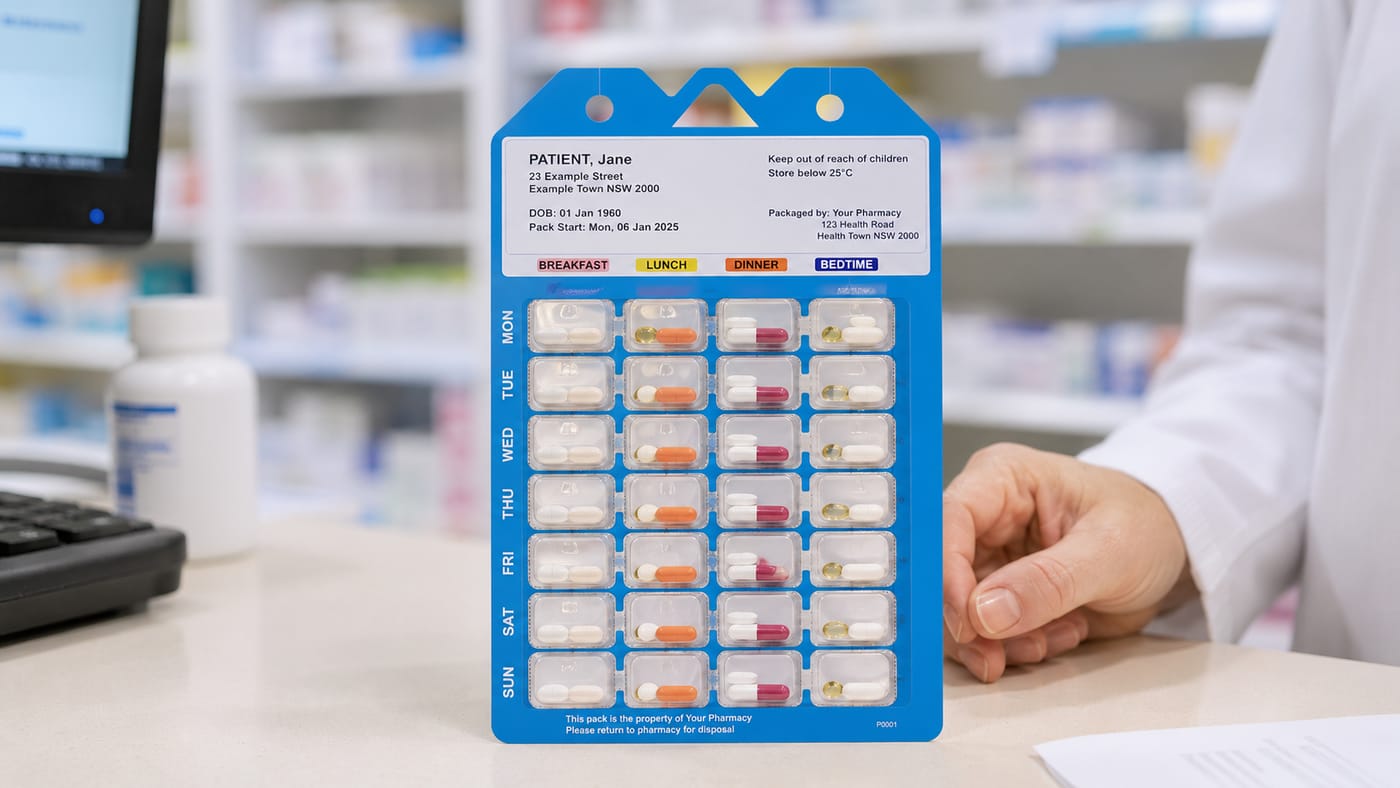
Each pocket holds the medicines for one day and time, and you peel the foil when it is due. If your doctor changes a dose partway through the week, the pharmacy remakes the rest of the week.
"Webster pack" comes from Webster-pak, a Webstercare brand name that many people use for any pharmacy blister pack. Pharmacies also use other brands and sachet-style packs. They all do the same job, so the brand your pharmacy uses makes no real difference to you.
The technical term used by Australian regulators and the federal funding program is "Dose Administration Aid".
Is a Webster pack right for you?
The Pharmacy Programs Administrator describes DAAs as being for people who have trouble managing the timing of their medicines. A pack tends to suit anyone in one of these situations.
- Take five or more regular medicines.
- Have memory or cognitive difficulties that make missed doses likely.
- Are recently discharged from hospital with a complex regimen.
- Are managed by a carer who needs a clear, error-resistant medication system.
- Have several chronic conditions with different specialists prescribing.
- Have a visual impairment that makes reading bottle labels difficult.
Pharmacists often suggest a Webster pack after a MedsCheck or Home Medicines Review shows that keeping track of doses has become hard.
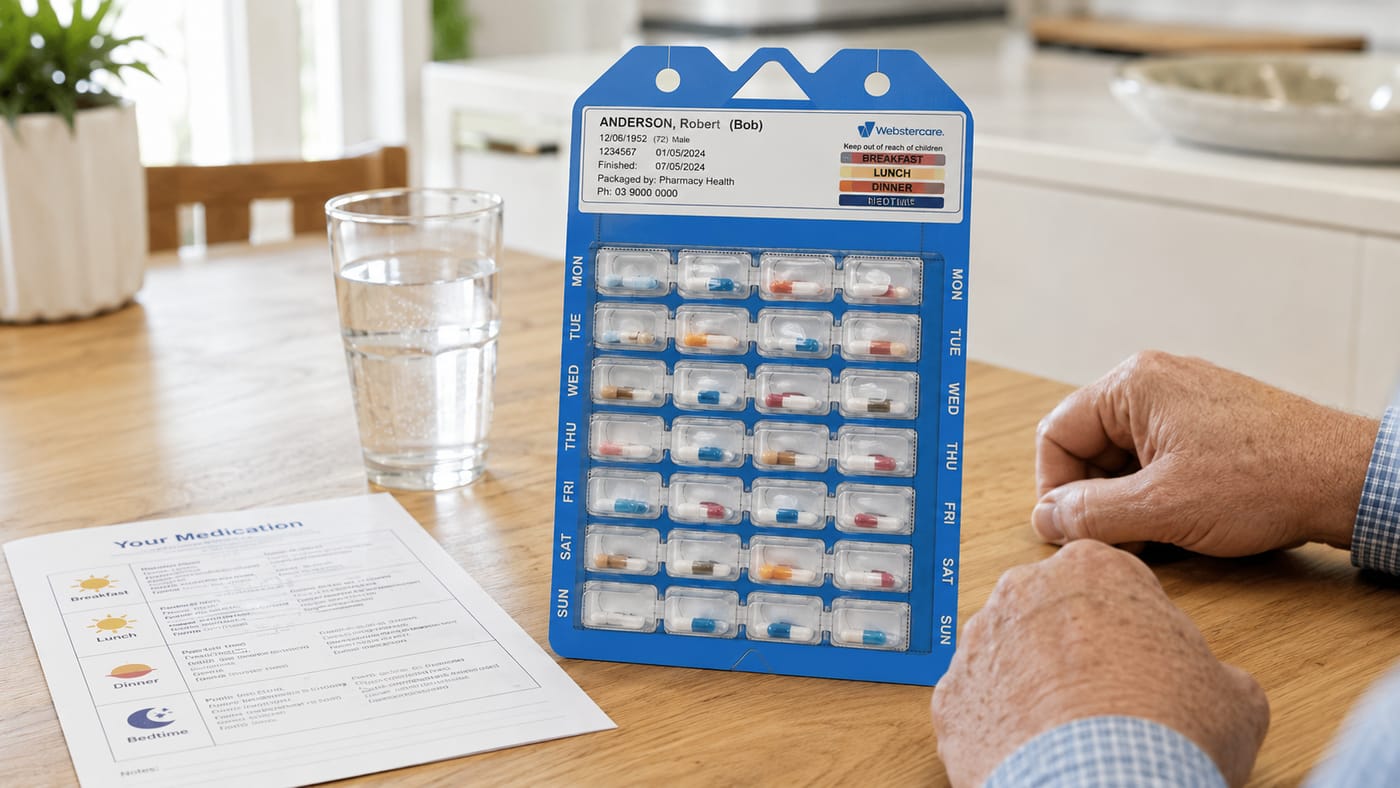
A sealed tray and a simple schedule together make it easy to see what has been taken and what is still due, which is often what reduces missed doses.
How much does a Webster pack cost, and who pays?
Cost depends on your pharmacy and whether you qualify for federal funding. There are three common patterns.
| How you pay | Who it applies to | The packing cost |
|---|---|---|
| Federal DAA Program | Concession card holder living at home who has difficulty managing their medicines, including those taking five or more | Subsidised, though the pharmacy may add its own charge |
| Pharmacy-funded | Some chains and competitive independents, offered as a customer service | Free |
| Private weekly fee | Everyone else | A weekly fee that varies by pharmacy |
Pharmacy Programs Administrator, DAA Program. You still pay the normal PBS co-payment for each medicine inside.
Pattern 1: Subsidised through the federal DAA Program
Eligible Australians can get subsidised packing through the Pharmacy Programs Administrator's DAA Program. The Pharmacy Programs Administrator sets the criteria, and a concession card is central to them: you hold a Medicare or Department of Veterans' Affairs (DVA) card, you live at home rather than in residential aged care, and you hold a current government-issued concession card. On top of that, you either have difficulty managing your medicines (for reasons including physical disability, cognitive difficulty, or a language or literacy barrier) or take five or more prescription medicines and have trouble managing them. Your community pharmacist assesses this and confirms your eligibility.
The program pays each participating pharmacy a weekly fee for each eligible patient, up to a weekly cap on the number of services it funds. The DAA Program Rules leave it to each pharmacy to decide whether to add its own charge for the packing, so it is worth asking what you will pay before you start. You still pay the normal PBS co-payment for each medicine inside. In 2026 that is $7.70 per medicine for concession card holders, compared with the general co-payment of $25.00 for Medicare card holders, reduced from $31.60 on 1st January 2026, according to the Australian Government.
Pattern 2: Pharmacy-funded free service
Some pharmacies, particularly chains and competitive independents, offer Webster packs free as a customer service. You pay for the medicines at PBS rates, and the pharmacy absorbs the packing labour. It is worth asking your local pharmacy whether they do this.
Pattern 3: Private fee
If you do not qualify for the DAA Program and your pharmacy does not absorb the packing cost, a weekly fee applies, paid directly to the pharmacy. Costs vary widely between pharmacies, so it can pay to compare a few before settling.
The DAA Program does not cover people living in residential aged care, as the Pharmacy Programs Administrator confirms. If you live in an aged care home, the home usually arranges packing through its pharmacy and can tell you whether there is any cost to you.
How to set up a Webster pack
Setting one up is straightforward, and it takes about four steps.
Your pharmacist may recommend a Home Medicines Review first, especially if you take many medicines, so the pack reflects your current prescriptions. Some pharmacies prefer fortnightly cycles to reduce trips and waste, though one week per pack is the standard.

Your pharmacist fills and checks the tray against your current prescriptions, so each sealed pocket matches what your prescriber intends before you take it home.
What is typically included in a Webster pack
Most pharmacies pack the medicines you take on a fixed daily schedule.
- All regular oral prescription medicines.
- Regular daily supplements like vitamin D or calcium, on request.
- Some 'when required' (PRN) medicines if explicitly agreed (less common).
Some items usually sit outside the pack, either because they are not taken on a set schedule or because they need different handling. That normally covers "when required" medicines like relievers or occasional pain relief, liquid medicines, inhalers, eye drops, creams and patches, refrigerated medicines like insulin, and anything you have started since the last pack was sealed, for which the pharmacy prepares a separate partial pack.
If your GP increases a dose, adds a new medicine, or stops one, the pharmacy redoes the rest of the week, so it helps to let them know when something changes.
How to move your Webster pack to another pharmacy
You can change pharmacies at any time. The new pharmacy will usually want your current sealed pack so it can see what was inside, your current prescriptions (paper or eScript tokens) or your agreement to transfer them, and a list of any non-prescription medicines or supplements in the pack.
The new pharmacy sets up a fresh pack, usually within a few days, and you can keep using your existing sealed packs until the new ones are ready.
Carer pickup and delivery
If you are a carer, you can collect the pack on behalf of someone else. The pharmacy may ask you to confirm you are authorised, particularly where the pack contains Schedule 8 medicines. It may also ask for ID and a note from the person being cared for.
A sealed weekly tray makes it simple for a family member or carer to see what is due, and many pharmacies deliver, which helps if getting to the pharmacy is hard. Delivery charges vary between pharmacies, and some deliver at no charge to regular DAA customers.

What happens when you go into hospital or respite
If you are admitted to hospital, the hospital usually takes over your medication management for the stay. It helps to mention you are on a Webster pack, and hospitals generally ask you to bring the current pack so the admitting team can see exactly what you have been taking.
Respite care works the same way: the respite facility manages medications during your stay, so your current pack goes with you. When you go home, your community pharmacist resumes the Webster pack cycle.
Talk to someone now
Free advice for questions about a medicine, dose, or interaction.
Frequently asked questions
It depends on how the packing is funded. The federal DAA Program subsidises the packing for eligible concession card holders, and each pharmacy decides whether to charge anything on top. Some pharmacies also offer packing at no charge as a customer benefit. Otherwise a weekly fee applies, paid directly to the pharmacy and varying from one to the next. The medicines inside are charged separately at the usual PBS rate whichever route you fall under.
Not always. A Pensioner Concession Card is one of the criteria for the federal DAA Program, but you also need to live at home in the community rather than in residential aged care and have difficulty managing your medicines. If you qualify, the program subsidises the packing, although your pharmacy can still add its own charge. You still pay the $7.70 concessional PBS co-payment for each medicine inside.
Your community pharmacist decides, using the Pharmacy Programs Administrator rules. You need a current government-issued concession card, you must live at home rather than in residential aged care, and you have difficulty managing your medicines, whether from a disability, a cognitive or language barrier, or from taking five or more prescription medicines and finding them hard to keep track of. One point people miss: a PBS Safety Net card does not count as an eligible concession card for this program, though a Pensioner Concession Card, Health Care Card, Commonwealth Seniors Health Card, or Department of Veterans' Affairs (DVA) Gold, White or Orange card does. Veterans with one of those DVA cards may instead be able to use the separate DVA medicine organiser service, which their GP can prescribe. Aboriginal and Torres Strait Islander people may be eligible for the Indigenous DAA program instead, which does not require a concession card and does not allow the pharmacy to charge for the service.
Yes, and there is no lock-in. The main thing to arrange is your prescriptions: your new pharmacy can arrange to transfer them, so you do not have to organise that yourself, and it will prepare your first pack within a few days.
Yes. If a carer collects regularly, some pharmacies keep a standing note on file so it is not queried each week, and many deliver instead, which removes the trip altogether. Where a pack contains Schedule 8 medicines, the pharmacy may check that the carer is authorised.
A Webster pack is a brand of blister-style DAA. "Blister pack" is a broader term that can also mean the manufacturer-supplied tablet strips that some medicines come in. The DAA blister you get from a pharmacy is what most Australians mean by "Webster pack" or "blister pack" in everyday conversation. Find a pharmacy that does Webster packs near you → Browse pharmacies offering DAA services