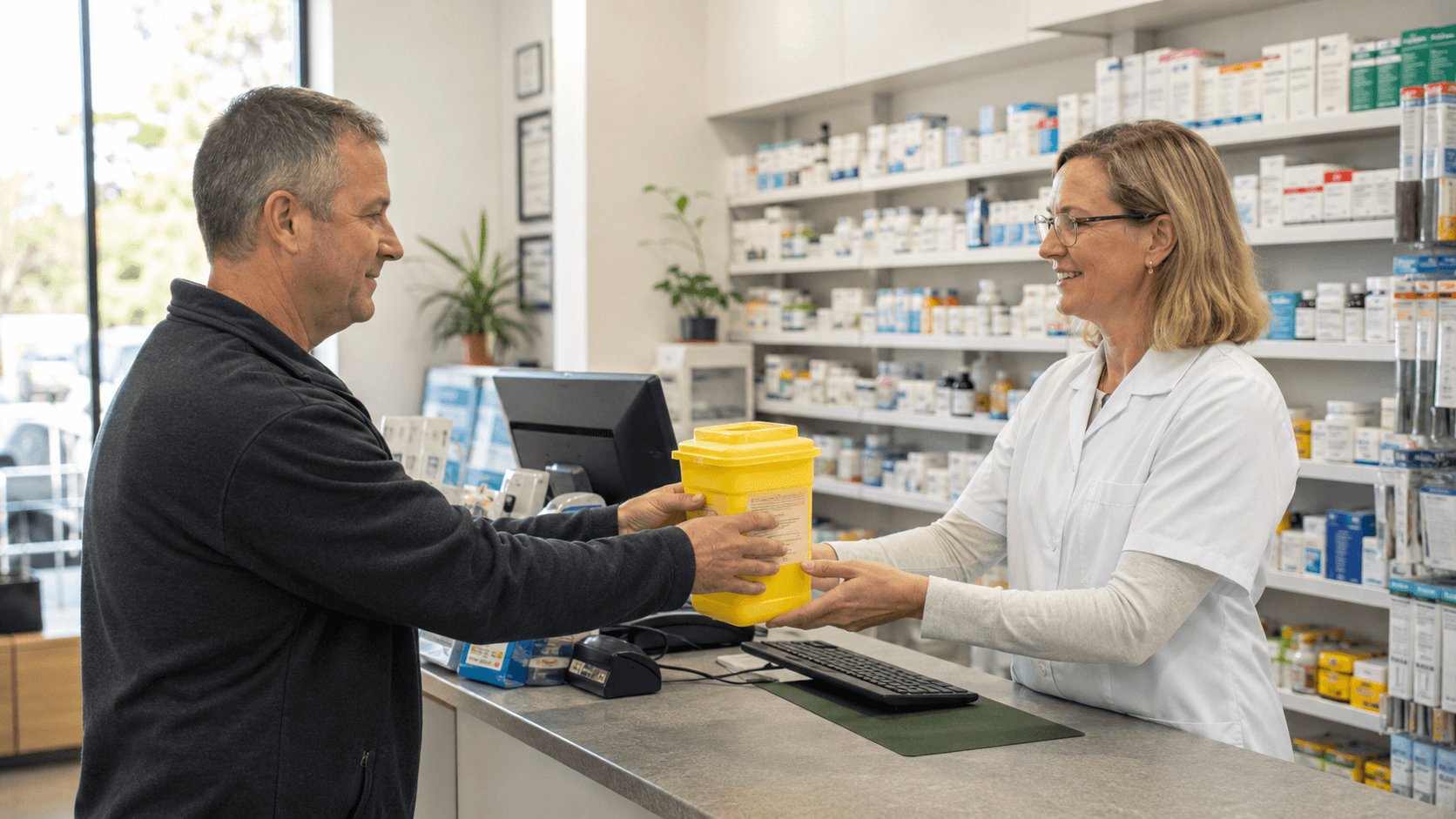
If you use an injectable medicine at home, the National Diabetes Services Scheme (NDSS) lists participating pharmacies among the places that take a filled sharps container, so it is worth calling ahead to check that your pharmacy does and whether it charges a fee. Sharps containers that meet Australian standards are sold at many pharmacies and online, according to NSW Health, and some councils and community health services supply them. State and territory health departments advise that used needles should never go loose in the household bin, where they put waste-collection workers at risk. The NDSS advises sealing them in a strong, puncture-proof plastic container with a screw top, either an Australian Standard sharps container or another strong plastic container.
General information, not medical advice
This guide explains how things work in general. It cannot tell you what is right for you, so check anything that affects you with your pharmacist or GP.
Always read the label and follow the directions for use.
Based on official Australian government and health sources. Rules can change.
Who needs sharps disposal
Anyone who injects a medicine at home builds up sharps that cannot go loose in the rubbish. That includes people with diabetes who use insulin pens or syringes, people on injectable blood thinners, people going through in vitro fertilisation (IVF) with injectable fertility medicines, people on injectable treatments for autoimmune conditions or migraine, people on injected hormone therapy, and anyone who carries an adrenaline auto-injector. People who use a Needle and Syringe Program have their own disposal route, and healthdirect lists local services in its Needle and Syringe Program finder.
How the pharmacy disposal scheme works
Participating pharmacies accept a filled sharps container, store it in a secured clinical-waste area, and have a licensed contractor collect it. Whether you pay depends on the pharmacy and on local arrangements, so ask when you call. In Queensland, for example, Queensland Health says the funded disposal facilities in some community pharmacies are only for used Needle and Syringe Program equipment. If you inject a medical, cosmetic or therapeutic substance in Queensland, Queensland Health says to ask your prescriber or treating clinician about a disposal container, or buy one from a pharmacy or medical supplier.
Disposal comes down to four steps.
Pharmacies that take sharps may have their own rules on which containers they accept, so it is worth asking when you call. Arrangements vary by state and run through a mix of pharmacies, councils, hospitals, and community health services, so your state health department or council has the local detail.

Only some pharmacies accept sharps, so a quick call before you visit saves a wasted trip.
What size container do you need?
The standard container is a rigid yellow plastic bin with a sealing lid, marked with the biohazard symbol and the word "Sharps". Ask the pharmacist which container size suits how much you use.
What counts as a sharp, and what does not
Into the sharps container go needles (used or unused, on a pen or loose), syringes with needles attached, insulin pen needles, blood-glucose lancets, activated auto-injectors, glass medicine ampoules, and any scalpel or suture needles issued for home use. Several items do not belong there: broken household glass (wrap and tape it, then put it in the general rubbish), empty plastic medicine bottles (rinse and recycle them), mercury thermometers (a council hazardous-waste point), and used bandages or gauze (household rubbish in a sealed bag). Expired or unwanted medicines have their own pathway, the Return Unwanted Medicines (RUM) Project, which its website says is free at community pharmacies across Australia, so it is best to keep medicines and sharps apart.
Once the lid is closed securely, hand the whole container to the pharmacist. They store it securely until the licensed contractor collects it.
If your pharmacy does not take part
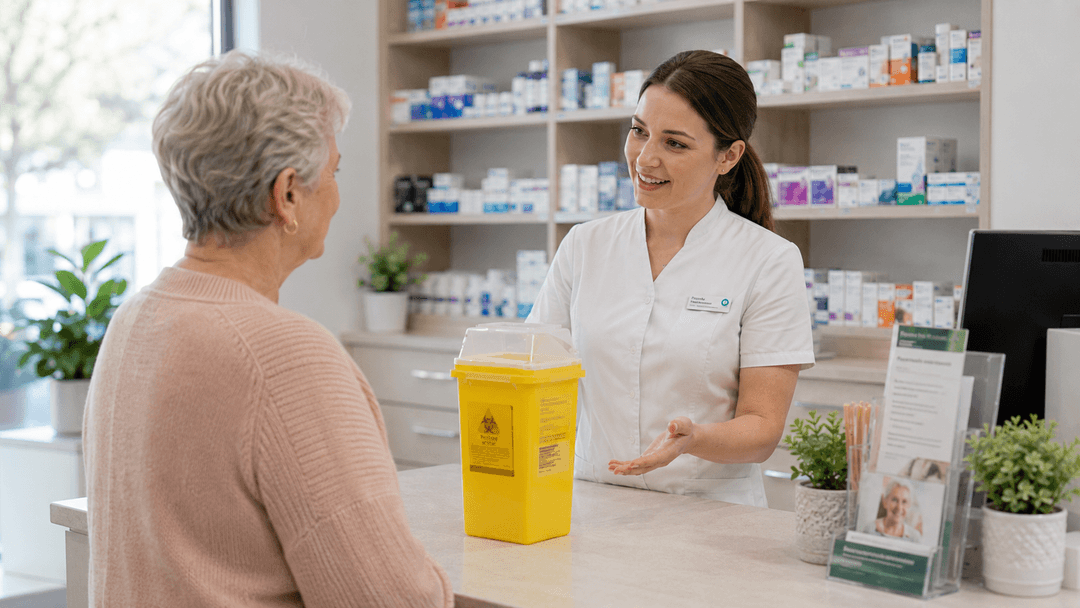
Where a local pharmacy does not run the scheme, your council is the next stop. Many councils provide community sharps bins, for example in public toilets and parks, according to NSW Health, and some accept sharps at waste transfer stations, according to Queensland Health. Public hospitals are another option listed by the NDSS. Your council's website lists the local arrangement. In South Australia, SA Health advises calling the Alcohol and Drug Information Service on 1300 131 340 for your nearest sharps disposal outlet. If you use diabetes injections, the NDSS Helpline is on 1800 637 700, Monday to Friday, 8.30am to 5pm (eastern time). If you find a discarded needle in New South Wales, NSW Health advises that you do not touch it and call the NSW Needle Clean Up Hotline on 1800 633 353. In the Australian Capital Territory (ACT), ACT City Services lists the Access Canberra 24-hour Sharps Hotline on 13 22 81 for reporting needles found on public land.
Talk to someone now
Free advice for questions about a medicine, dose, or interaction.
Frequently asked questions
It depends on the pharmacy and on local arrangements, so ask about any fee when you call ahead. You may also need to buy a replacement container.
According to state health guidance, a loose, unsealed needle should never go in any bin. Health departments generally direct you to seal sharps in a puncture-proof container and return it through a pharmacy, public sharps bin, hospital or Needle and Syringe Program. The rules on household bins differ. Queensland Health says some Queensland council areas allow sharps sealed in a suitable rigid plastic container in the general rubbish bin, and advises checking with your council first. In the Australian Capital Territory, ACT City Services says used sharps must not go in household bins, even sealed in a sharps container. In Western Australia, HealthyWA says to put a sealed, rigid plastic container in a domestic rubbish bin, never a recycling bin. Your state health department or council can confirm the local rule.
A milk or drink bottle may not be puncture-proof, and HealthyWA advises avoiding frosted plastic for this reason. The National Diabetes Services Scheme (NDSS) advises a strong, puncture-proof plastic container with a screw top, and NSW Health gives an empty laundry detergent bottle as an example. Pharmacies may have their own rules on which containers they accept, so it is worth asking before you take one in.
Not in the sharps container. Unwanted or expired medicines go back through the separate Return Unwanted Medicines Project, at the pharmacy counter.