Pharmacy guides

Needle and Syringe Program at Australian Pharmacies

By Editorial team. Updated . 7 minute read.

General information

This guide is general information, not personal medical advice, and may change over time. Always check anything that affects you with your pharmacist or GP. In an emergency, call 000.

The Needle and Syringe Program (NSP) is a federally funded public-health initiative that supplies sterile injecting equipment and safe disposal across every Australian state and territory. Community pharmacies are one of the largest delivery channels. Most participating pharmacies supply equipment free or at low cost, accept used equipment back for disposal in approved sharps containers, and do so without recording your name or asking why. The program operates in tandem with primary NSP sites run by state health departments and community health services. For an overview of sensitive-services available at pharmacies, see our sensitive services guide.

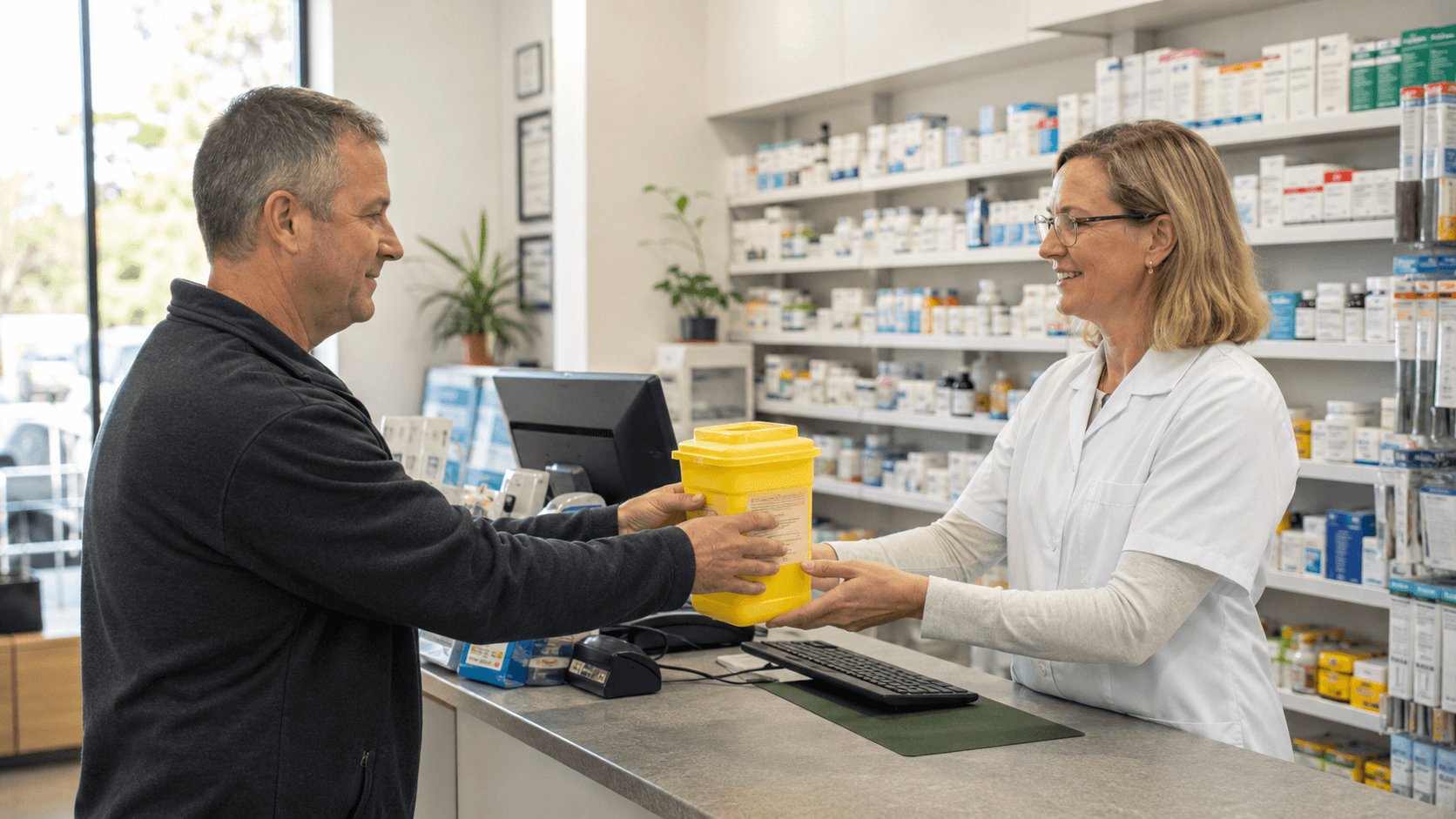
A pharmacist helping a customer at the counter of an Australian community pharmacy.

Key facts

  • The NSP is a federally and state-funded public-health programme operating in Australia since 1986.
  • Participating pharmacies supply sterile injecting equipment and accept used equipment for safe disposal.
  • At pharmacies, a fitpack commonly costs $2 to $5; primary NSP sites are generally free.
  • The programme is anonymous: no name, no ID, no Medicare card required.
  • State health departments and peer organisations publish locators of participating sites.

This guide explains what the NSP is, what pharmacies provide under it, what anonymity looks like in practice, and how to find a participating pharmacy.

What NSP is

The Needle and Syringe Program is the public-health harm-reduction service that supplies sterile injecting equipment to people who inject drugs, and provides safe disposal of used equipment. It has operated in Australia since 1986 and is jointly funded by the federal Department of Health, Disability and Ageing and the state and territory health departments.

The federal Department of Health publishes its NSP policy at health.gov.au. The Australian peak body for NSP services is the National Network of Alcohol and other Drugs Agencies (NADA), and the Australian Injecting and Illicit Drug Users League (AIVL) represents people who use the service.

The Department of Health states that the program is one of the most cost-effective public-health interventions in Australia's history. Australian Government program documentation attributes substantial reductions in blood-borne virus transmission to NSP operation since the late 1980s.

What pharmacies provide

A participating community pharmacy supplies:

  • Sterile single-use syringes in a range of sizes
  • Sterile needles, individually packaged
  • Sterile water ampoules
  • Swabs and other ancillary equipment (filters, spoons, tourniquets) where stocked
  • An approved sharps container or fitpack for transport and disposal
  • A return service that accepts used equipment for safe disposal

Supply at pharmacies usually takes the form of a "fitpack": a sealed container holding a small number of syringes, needles, water, swabs, and a built-in sharps disposal compartment. Most pharmacies charge a small fee for a fitpack, commonly around $2 to $5, though some supply it free under their state's funding arrangement. Equipment supplied at a primary NSP site is generally free.

The Pharmaceutical Society of Australia publishes professional practice standards for NSP supply at psa.org.au.

Anonymity

You do not need to give your name, show identification, or hold a Medicare card to access the NSP. You do not need to explain why you are collecting equipment. The pharmacist's role is to supply safely and to be available for any question you have, not to record who you are.

Some practical points:

  • The pharmacy does not maintain a register of NSP users
  • Your transaction is not reported to Medicare or to your GP
  • If you pay by card, the transaction will appear on your bank statement as a purchase from the pharmacy (the pharmacy name only)
  • Cash payment leaves no record at all

Pharmacists are bound by the same confidentiality rules they apply to every other consultation. Pharmacy Board of Australia professional standards at pharmacyboard.gov.au make clear that confidentiality applies regardless of the reason for the visit.

Primary NSP versus pharmacy NSP

Two service models operate side by side.

Primary NSP sites are dedicated services, usually run by a state health department, a community health centre, or a non-government drug-and-alcohol organisation. They typically supply equipment free of charge in larger quantities, can supply secondary equipment that pharmacies do not stock, and have staff trained specifically in harm reduction and blood-borne virus referral. They are also able to refer directly into other services, including hepatitis C treatment, drug-and-alcohol treatment, mental-health support, and primary care.

Pharmacy NSP is the community pharmacy model. Hours are longer (every shopping strip, evening and weekend coverage), the location is closer for most people, and a fitpack can be picked up in two minutes alongside any other purchase. Quantity per visit is usually smaller, and the fee is typically $2 to $5.

The two models complement each other. Many people use both: pharmacy NSP for routine top-up access during the week, primary NSP for larger collections or when broader support is wanted.

FeaturePrimary NSPPharmacy NSP
Run byState health, community health, or NGOCommunity pharmacy
CostGenerally freeFitpack commonly $2 to $5
HoursOffice hours typicallyEvening and weekend coverage
Quantity per visitLargerSmaller
ReferralsDirect into hepatitis C, drug-and-alcohol, mental-health, primary careLimited to pharmacy services
General information drawn from publicly available sources, which can change. Check anything that affects your situation with your pharmacist.

State health departments publish lists of both pharmacy and primary NSP outlets. See health.nsw.gov.au, health.qld.gov.au, and your state's equivalent for the locator most relevant to where you live.

Finding a participating pharmacy

Three reliable routes:

  1. State health department NSP locator. Each state health department publishes an online map or list of participating sites. NSW Health, Queensland Health, the Victorian Department of Health, WA Health, SA Health, Tasmanian Department of Health, NT Health, and ACT Health all maintain current locators.
  2. NUAA (NSW) and equivalent state peer organisations. Peer-led organisations maintain user-facing locators and can be contacted directly for advice on which sites are most welcoming and which are the closest. NUAA operates in NSW; equivalent peer groups exist in each state.
  3. Call ahead. If you are unsure whether your local pharmacy participates, phone and ask. Not every community pharmacy joins the NSP; participation is voluntary at the pharmacy level. A pharmacy that does not participate cannot turn you away rudely; the pharmacist's professional code requires they refer you to a nearby site that does.

For 24-hour and late-night access, the directory's late-night listings include several pharmacies that participate in NSP. Coverage in regional and remote Australia is lower; primary NSP sites and outreach services are sometimes the only option, and a phone call to the state health department's NSP line will direct you.

What to do with used equipment

Bring used equipment back to any participating pharmacy in an approved sharps container or in the original fitpack. The pharmacy will accept it for disposal. There is no charge to return used equipment, and the disposal does not generate a record.

If a pharmacy is not available:

  • Primary NSP sites accept used equipment, often in larger quantities
  • Some local councils run sharps collection points; check your council's website
  • Many hospitals accept used equipment at their emergency departments without question
  • Never put loose needles or syringes in a household bin, recycling bin, or street rubbish bin

For people using injectable medicines for medical reasons (insulin, anticoagulants, IVF), the standard community pharmacy sharps disposal scheme applies and is described separately in our sharps disposal guide.

Talk to someone now

Free advice for questions about a medicine, dose, or interaction.

Frequently asked questions

At primary NSP sites, yes. At community pharmacies, a fitpack usually costs $2 to $5, though some pharmacies supply it free under their state's arrangement. There is no charge to return used equipment.

Was this guide helpful?

Related guides

Interior of an Australian community pharmacy showing wellness, skincare and prescription sections.Finding the Right Pharmacy

How to Find a 24-Hour Pharmacy in Australia

True 24-hour pharmacies are rare in Australia. Fewer than ten nationwide. Most capital cities have one or two; large regional centres usually have none. When you need medication overnight or on a public holiday, what helps is knowing which pharmacies in your city stay open latest, what to do when none are open, and when to call healthdirect on 1800 022 222 instead.

Updated 29 May 2026.

Find a pharmacy near you

Search 4,400+ verified Australian pharmacies by service, hours or postcode.

Find a pharmacy