An accessible pharmacy is more than a ramp at the door. Step-free entry, a counter you can use from a wheelchair, a hearing loop, large-print labels, and the right to bring an assistance animal all decide whether a visit works or falls apart. Australian pharmacies vary widely, and a directory listing shows only some of this, so a quick phone call is often the fastest way to confirm what a pharmacy actually offers. This guide covers what to look for, how the National Disability Insurance Scheme (NDIS) fits in, and the questions worth asking before you go. For the wider picture, see our guide to finding a pharmacy in Australia.
General information, not medical advice
This guide explains how things work in general. It cannot tell you what is right for you, so check anything that affects you with your pharmacist or GP.
Always read the label and follow the directions for use.
Based on official Australian government and health sources. Rules can change.
What makes a pharmacy accessible?
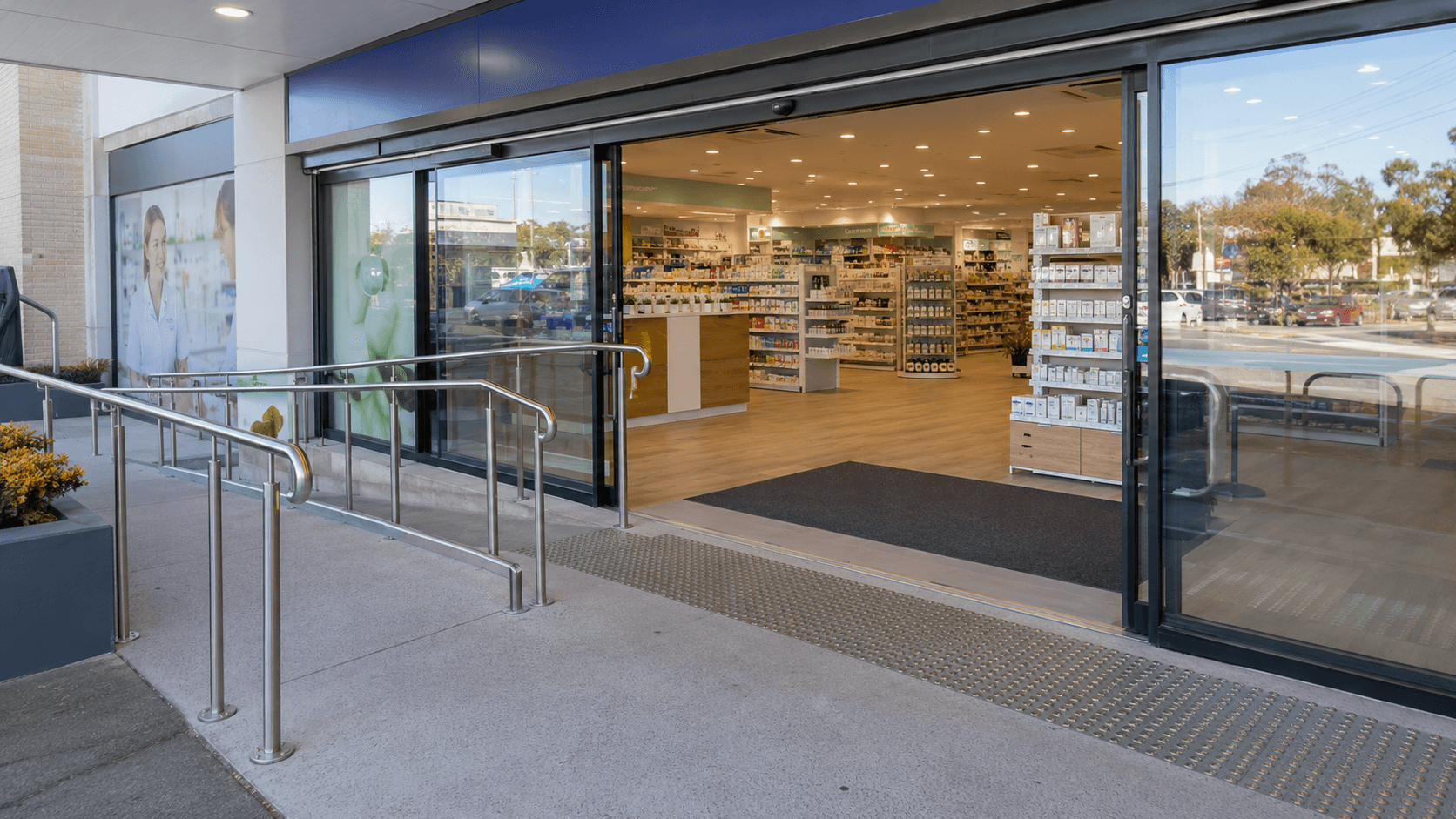
Step-free entry and a wide door. A pharmacy you can enter without a step, from the street or the car park, with a doorway wide enough for a wheelchair or walking frame. Under the national Premises Standards, new buildings and building work where approval was applied for on or after 1st May 2011 need accessible doorways built to the Australian Standard AS 1428.1, which sets a clear opening of at least 850 millimetres. The Premises Standards do not require an older shopfront to be upgraded unless new building work is done, so some still have a step at the entrance.
A counter you can actually use. The standard pharmacy counter is built for a person standing, which puts it above eye level for many wheelchair users. A genuinely accessible pharmacy has a lowered section of counter, low enough to use while seated, with clear space underneath so a wheelchair can roll straight up. A private consultation room with a low table is better still.
A hearing loop. This sends the pharmacist's voice straight to a hearing aid switched to the "T" setting, which cuts through the background noise of a busy shop. The symbol to look for near the counter is an ear with a "T" inside it.
The right to bring an assistance animal. Under the Disability Discrimination Act 1992, it is generally unlawful for a pharmacy to refuse you entry because you have an assistance animal, including a guide dog or a hearing dog. The Act allows the pharmacy to ask that the animal stays under your control, and to ask for evidence that it is an assistance animal or is trained to meet hygiene and behaviour standards for a public place. If that evidence is not produced, the pharmacy can lawfully refuse entry, so it is worth carrying the animal's accreditation papers (Disability Discrimination Act 1992, Federal Register of Legislation).

For many people the hardest part of a pharmacy is reaching it. Many pharmacies offer delivery, so a regular medicine can come to your door, and you can often set it up by phone.
How do you get large-print medication labels?
You can ask your pharmacy whether it can print your dispensing labels in larger type. Some pharmacies can note this on your patient record so that future labels are printed the same way. It is worth asking for this on your first visit, along with a high-contrast instruction sheet, black on white, one medicine to a line, to sit alongside the box.
Some pharmacies may also offer audio labels, a small code you scan with a phone to hear the instructions read aloud, and your pharmacist can tell you whether that is available. If you have low vision, Vision Australia offers daily living and technology support that may help (Vision Australia).
How do you make a calmer, sensory-friendly visit?
A calmer visit is mostly a matter of timing. Many pharmacies are busiest at lunchtime, after school and at the end of the working day, and quieter on a weekday mid-morning, although this varies. If a busy pharmacy is hard for you or someone you care for, a few small adjustments help: you can call ahead to ask when they are at their quietest, ask to use a private consultation room rather than the open counter, and fill in any forms by phone or email beforehand so the visit itself is short. Some pharmacies run quieter sensory-friendly hours, so it is worth asking whether yours does.
Does the NDIS pay for pharmacy or medicines?
No. The NDIS does not pay for medicines. Your medicines still come through the Pharmaceutical Benefits Scheme (PBS), private payment, or another federal program, because medicines are treated as part of the health system rather than a disability support (NDIS Supports for Participants Rules, Federal Register of Legislation).
What an NDIS plan may fund is some disability-related health support, where it is written into the plan. One support the NDIS lists is help with subcutaneous injections, for example for diabetes management (Disability-related health supports, NDIS). A Home Medicines Review (HMR) is separate: it needs a referral from your GP or an eligible specialist, and it is funded by the Australian Government through the community pharmacy programs, at no charge to eligible patients (Home Medicines Review, Pharmacy Programs Administrator). The packing of a dose administration aid (DAA), the weekly blister pack many people use, can be subsidised through the federal DAA Program for eligible people, and the pharmacy may also charge its own fee (see our Webster packs and dose administration aids guide). For what your own plan covers, your NDIS planner or local area coordinator can confirm the detail (ndis.gov.au).
What should you ask before you go?
On Pharmacy Finder you can filter for pharmacies that deliver. The building details, step-free entry, a hearing loop, a low counter, or large-print labels, are best confirmed by a quick call, because a listing cannot capture all of them. Many pharmacies are happy to answer these questions, and if one cannot or will not, it is fine to choose another.
- Step-free entry. Is the entrance level, and is there accessible parking close by?
- A low counter. Is there a lowered counter or a consultation room you can use seated?
- A hearing loop. Is one fitted near the counter?
- Large-print labels. Can you set my record to print labels in large type?
- Delivery. Do you deliver, and what is the cut-off time?
- Quiet times. When is the pharmacy at its quietest?
Talk to someone now
Free advice for questions about a medicine, dose, or interaction.
Frequently asked questions
The essentials are step-free entry, a door with a clear opening of at least 850 millimetres, aisles wide enough to turn in, and a lowered section of counter with space underneath. Buildings and building work lodged for approval on or after 1st May 2011 must meet national access standards, but older shopfronts may not have been upgraded, so it is worth checking first.
Usually, yes. Under the Disability Discrimination Act 1992, it is generally unlawful for a pharmacy to refuse entry because a person has an assistance animal, including a guide dog. The pharmacy can ask that the dog stays under your control and can ask for evidence that it is an assistance animal or is trained to meet hygiene and behaviour standards, so it is worth carrying its papers.
No. The NDIS does not pay for medicines, which come through the PBS or private payment. It may fund some disability-related health support when that is written into your plan, but according to the NDIS, plan funds cannot be used to pay your share of the cost of PBS medicines either.
You can ask your pharmacy whether it can print your labels in larger type, and some pharmacies can save this on your record so later refills are printed the same way. If reading the print is hard, it is also worth asking whether the pharmacy offers audio labels or a plainer, higher-contrast printout.
Partly. It is strongest for finding pharmacies that deliver, which for some people removes the need to visit at all. For the physical details of a shopfront, the call-ahead questions above are the dependable route.