About 22% of Australians, more than five million people, speak a language other than English at home (2021 Census, cultural diversity, ABS). When your pharmacist speaks your language, the instructions for a medicine land clearly the first time, and it is easier to ask about a side effect or another medicine you already take. Many pharmacies in multicultural areas have staff who speak a major community language, and for anything that cannot be covered in person, the Translating and Interpreting Service (TIS National) offers phone interpreting at any hour, and most of its interpreting services are free to non-English speakers (Interpreting services, TIS National). For the wider picture, see our guide to finding a pharmacy in Australia.
General information, not medical advice
This guide explains how things work in general. It cannot tell you what is right for you, so check anything that affects you with your pharmacist or GP.
Always read the label and follow the directions for use.
Based on official Australian government and health sources. Rules can change.
Why does a shared language matter?
Medication instructions are precise, and small differences change what a medicine does. "Take with food" and "take on an empty stomach" work differently in the body; "once a day" and "every second day" can be the difference between a medicine helping and harming. Pharmacist counselling only does its job when you follow exactly what you were told.
A shared language lowers real risks. Doses are missed less often when the instructions are clear. The pharmacist can ask about your other medicines and catch a harmful combination. And you can describe a side effect accurately enough for them to act on it. This matters most for older people from migrant communities, for recent arrivals still building their English, and for anyone managing several medicines at once, where small misunderstandings add up over time.
How can you find a pharmacist who speaks your language?
Three approaches work well. Searching Pharmacy Finder by suburb or postcode gives you a list of nearby pharmacies and their phone numbers. Local knowledge is often quicker: cultural associations, places of worship, and community newspapers tend to know which pharmacies serve their community, especially in areas like Sydney's Cabramatta, Melbourne's Footscray, or Brisbane's Sunnybank. The surest method is to call ahead and ask whether someone who speaks your language is working on the day you plan to visit.
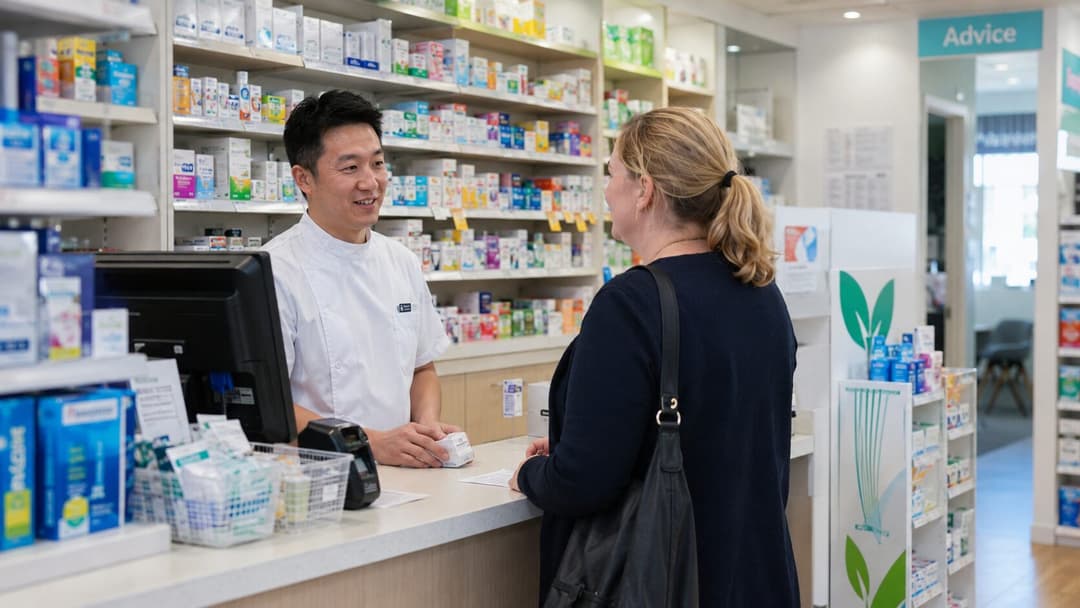
If no one on shift speaks your language, the pharmacy can add an interpreter to your conversation by phone, usually at no cost to you, through the national interpreting service, so you can still understand your medicine clearly.
How does TIS National work for a pharmacy visit?
TIS National is run by the Department of Home Affairs (TIS National), and its immediate phone interpreting service is available 24 hours a day, every day of the year (Interpreting services, TIS National). It works two ways at a pharmacy. You can call TIS yourself on 131 450, ask for an interpreter in your language, and the operator will then call the pharmacy and connect you and the interpreter to it (Interpreting services, TIS National). Or, while you are at the counter, the pharmacist can bring an interpreter onto the phone and into the conversation.
A community pharmacy can use the government's Free Interpreting Service when it has a Pharmaceutical Benefits Scheme (PBS) approval number or a pharmacist registered with the Australian Health Practitioner Regulation Agency (AHPRA), and when the patient is eligible for Medicare (Free Interpreting Service for pharmacies, TIS National). In that case, the interpreting service is free. If you are not eligible for Medicare, it is worth asking the pharmacy first whether an interpreter will cost anything.
A TIS phone interpreter is not necessarily a health specialist, and a general interpreter suits most pharmacy conversations. For a complex discussion about a chronic condition, it is worth asking whether a credentialed health interpreter is available; these are certified by the National Accreditation Authority for Translators and Interpreters (NAATI) (NAATI).
Common community languages by area
Australia's community-language map broadly tracks the migration history of each area, so the languages you are most likely to find in a pharmacy shift from suburb to suburb.
| Language | Suburbs where it is widely spoken at home |
|---|---|
| Mandarin and Cantonese | Sydney (Chatswood, Hurstville, Eastwood), Melbourne (Box Hill, Glen Waverley), Brisbane (Sunnybank) |
| Arabic | Sydney (Bankstown, Lakemba, Auburn), northern Melbourne (Coburg, Broadmeadows) |
| Vietnamese | Cabramatta (NSW), Footscray and Richmond (VIC), Inala (QLD) |
| Greek | Melbourne (Oakleigh, Northcote), Sydney (Marrickville, Earlwood), Adelaide (Norwood) |
| Italian | Melbourne (Coburg, Northcote), Sydney (Leichhardt, Five Dock) |
| Hindi and Punjabi | Melbourne (Tarneit, Point Cook), Sydney (Parramatta, Harris Park) |
| Korean | Sydney (Strathfield, Eastwood, Chatswood), Melbourne (Box Hill) |
ABS 2021 Census QuickStats. Each suburb listed has the language, or at least one language in the pair, among its five most common languages other than English used at home. Areas are indicative, and individual pharmacies vary. Many other languages, including Tagalog, Tamil, Spanish, Persian, Turkish, and Macedonian, are spoken in communities across the country.
How do you ask without any awkwardness?
Asking whether a pharmacist speaks your language is completely normal. You can ask in a few natural ways:
- "Hi, is there anyone here who speaks [language]?"
- "Is there a pharmacist on today who speaks [language]?"
- "I would be more comfortable in [language] for this. Is that possible?"
If the answer is no, you can ask the pharmacist to bring in a phone interpreter or to point you to a nearby pharmacy where someone speaks your language. The same questions work just as well over the phone if you are calling ahead.
What can you do in an urgent situation with no interpreter?
For an urgent question when no one in person can help, there are two good options beyond the TIS line already covered. Healthdirect on 1800 022 222 has a registered nurse at any hour, and if you need an interpreter, Healthdirect advises calling TIS National on 131 450 and asking to be transferred to the helpline (Contact us, healthdirect); if your concern is medical rather than only about medication supply, this is often the better first call. Healthdirect advises that if an injury or illness is critical or life threatening, you should call triple zero (000).
If a pharmacist cannot reach an interpreter quickly enough, it is worth asking them to write the key points down: the dose, how often to take it, what to do about a missed dose, and what to avoid. A short written list in English is something a family member, friend, or community contact can help you translate afterwards.
Talk to someone now
Free advice for questions about a medicine, dose, or interaction.
Frequently asked questions
Mandarin is the most common language other than English used at home in Australia, according to the ABS 2021 Census, so you have a good chance of finding a Mandarin-speaking pharmacist in the major cities. You can call your nearest large pharmacy and ask, particularly in the Sydney, Melbourne, and Brisbane suburbs where Mandarin speakers cluster.
Usually, yes. A community pharmacy can use the government's Free Interpreting Service when the patient is eligible for Medicare (Free Interpreting Service for pharmacies, TIS National), and TIS National says most of its interpreting services are free to non-English speakers. If you are not eligible for Medicare, it is worth asking the pharmacy first.
The Pharmacy Board of Australia's dispensing guidelines say the label should be printed in plain English, and that an accurate translation into another language may be added as well as the English (Guidelines for dispensing of medicines, Pharmacy Board of Australia). Whether a pharmacy can provide a translation varies, so it is worth asking at the counter.
It is worth calling a few pharmacies to ask, because the languages staff speak are often not listed online. If there is still no match, TIS National covers the gap by phone on 131 450, or your GP can add an interpreter to the consultation when you discuss a medication change.
Usually, yes. TIS National notes that hospital pharmacies follow their own hospital's interpreting policy (Free Interpreting Service for pharmacies, TIS National). In NSW, for example, NSW Health says patients have the right to free, confidential and professional interpreters when they use public health services (NSW Health Care Interpreting Services, NSW Health), so it is worth asking the hospital pharmacy for one.