Find a compounding pharmacy near you
A compounding pharmacy prepares medicines from raw pharmaceutical ingredients, made to order for a named patient on a valid prescription. Compounding exists because commercial medicines come in fixed doses, fixed forms, and fixed excipients, and that does not suit every patient. Find a compounding pharmacy near you using the search below.
 Compounding lab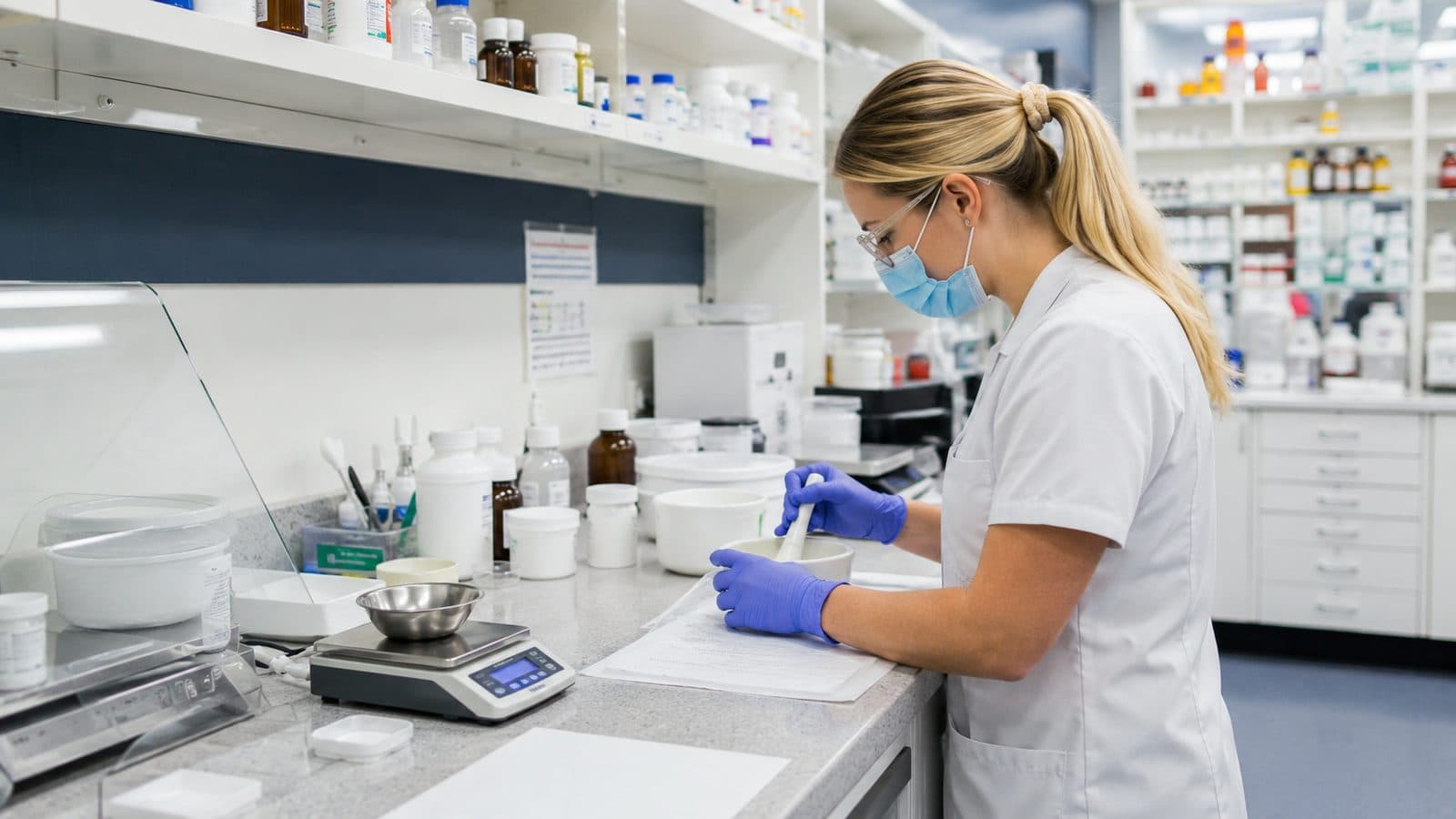
Compounding pharmacies

Jerramungup Pharmacy AMCAL
9 Memorial Rd, Jerramungup WA, 6337

Prospect Compounding Pharmacy
904 Howitt Street, Wendouree VIC, 3355

Capital Chemist Orange
Bloomfield Medical Centre, Suite 2 Ground Floor/1521 Forest Rd, Orange NSW, 2800
Remedy Dispensary & Compounding
93 Main St, Mornington VIC, 3931

TERRYWHITE CHEMMART GREENWAY MEDICAL
5/175 Anketell St, Greenway ACT, 2900

Pharmacy 777 High Wycombe
33 Newburn Rd, High Wycombe WA 6057, High Wycombe WA, 6057

Trigg Medical Pharmacy
131 Lynn St, Trigg WA, 6029

ALLAN LEE PHARMACY - Chemist Seven Hills
14 Sydney Joseph Dr, Seven Hills NSW, 2147
Hume City Pharmacy
510 Barry Rd, Coolaroo VIC, 3048

Direct Chemist Outlet Showgrounds
320/380 Epsom Rd, Ascot Vale VIC, 3032

Buckley Street Compounding Pharmacy
357 Buckley St, Aberfeldie VIC, 3040

Zenith Pharmacy Parramatta
Westfield Shopping town(Corner of Argyle &, 13 Marsden St, Parramatta NSW 2150, Parramatta NSW, 2150
Browse all 238 pharmacies offering compounding across Australia
Related services
Explore other pharmacy services available across Australia.
When would you need a compounding pharmacy?
Your GP or specialist might refer you to a compounding pharmacy when the commercial version of a medicine does not work for your situation. Common reasons include an allergy to an inactive ingredient in the standard product, a dose that falls outside what manufacturers produce, a child who cannot swallow a tablet and needs a flavoured liquid, a medicine on extended backorder through the TGA shortage register, or a preparation combining two active ingredients that are not commercially available together.
Vets also prescribe compounded medicines regularly, particularly for animals that will not accept standard tablet forms. A compounding pharmacist can prepare the active ingredient in a form the animal will take at a dose appropriate for its weight.
What types of compounding are available?
Most compounding pharmacies in Australia offer non-sterile preparations: capsules, creams, gels, ointments, oral liquids, lozenges, and troches. Sterile compounding, which covers injectables and eye drops, needs a dedicated cleanroom and is available at fewer pharmacies. Paediatric and dermatology compounding are common, and veterinary compounding is widely available. If your prescription needs a sterile preparation, confirm the pharmacy has the right facilities before you go.
For a detailed explanation of how compounding works, what it costs, how it is regulated in Australia, and questions to ask before choosing a pharmacy, read the full compounding pharmacy guide.
Do you need a prescription?
For any preparation containing a Schedule 4 or Schedule 8 active ingredient, yes. The prescription must come from a registered Australian practitioner and must name you specifically. Digital prescriptions are accepted by most compounding pharmacies. For veterinary preparations, a current prescription from a registered vet naming the animal is required.
Since 1 October 2024, pharmacists in Australia cannot compound GLP-1 receptor agonist medicines. This applies nationally, regardless of whether a prescription is presented.
Is compounding covered by the PBS?
Almost never. Compounded preparations are private prescriptions in most cases, so you pay the full cost. There is one specific exception: the Chemotherapy Compounding Payment Scheme (CCPS) provides payment for eligible PBS-linked chemotherapy compounding in defined circumstances.
For a standard non-sterile preparation such as a flavoured liquid or custom-strength cream, $50 to $120 or more per preparation is a general starting point. Costs vary by pharmacy, ingredients, and complexity. Most compounding pharmacies will give you a written quote before you commit.
Good to know
Finding compounding pharmacies
Quick answers to common questions.
Use the search above to find compounding pharmacies by suburb or postcode. Not every compounding pharmacy offers every type of preparation, so call ahead to confirm they can prepare your specific prescription before you go.
Yes, for preparations containing a Schedule 4 or Schedule 8 active ingredient. The prescription must name you and come from a registered Australian practitioner. A digital prescription is accepted by most pharmacies. For veterinary preparations, a registered vet must write the script naming the animal.
Many compounding pharmacies in Australia operate online and post preparations nationally. Upload a valid prescription, they prepare the medicine, and it is dispatched to your address. Useful if you are in a regional or rural area with limited local options. Confirm the pharmacy holds current registration in its home state or territory before ordering.
Turnaround depends on the preparation type and the pharmacy's workload. Simple non-sterile preparations such as capsules or creams can be ready within one to two business days. More complex or sterile preparations may take longer. Ask the pharmacy for a realistic timeframe when you submit your prescription.
Compounding pharmacies in Australia operate under the Pharmacy Board of Australia's Guidelines on Compounding of Medicines and must source ingredients from TGA-licensed or TGA GMP-certified suppliers. State and territory pharmacy councils add a further registration layer. You can verify a pharmacist's registration at the Australian Health Practitioner Regulation Agency (AHPRA) register. Talk to your GP or pharmacist if you have specific questions about how your preparation will be made.
Sources
This page is general health information for educational purposes only. It is not personal medical or pharmaceutical advice, does not constitute a recommendation of any medicine or preparation, and does not establish a practitioner-patient relationship. Speak to your GP or pharmacist about whether a compounded medicine is appropriate for your situation.