General information
This guide is general information, not personal medical advice, and may change over time. With any medicine, always read the label and use only as directed, and if symptoms persist see your doctor or health care professional. Check anything that affects you with your pharmacist or GP. In an emergency, call 000.
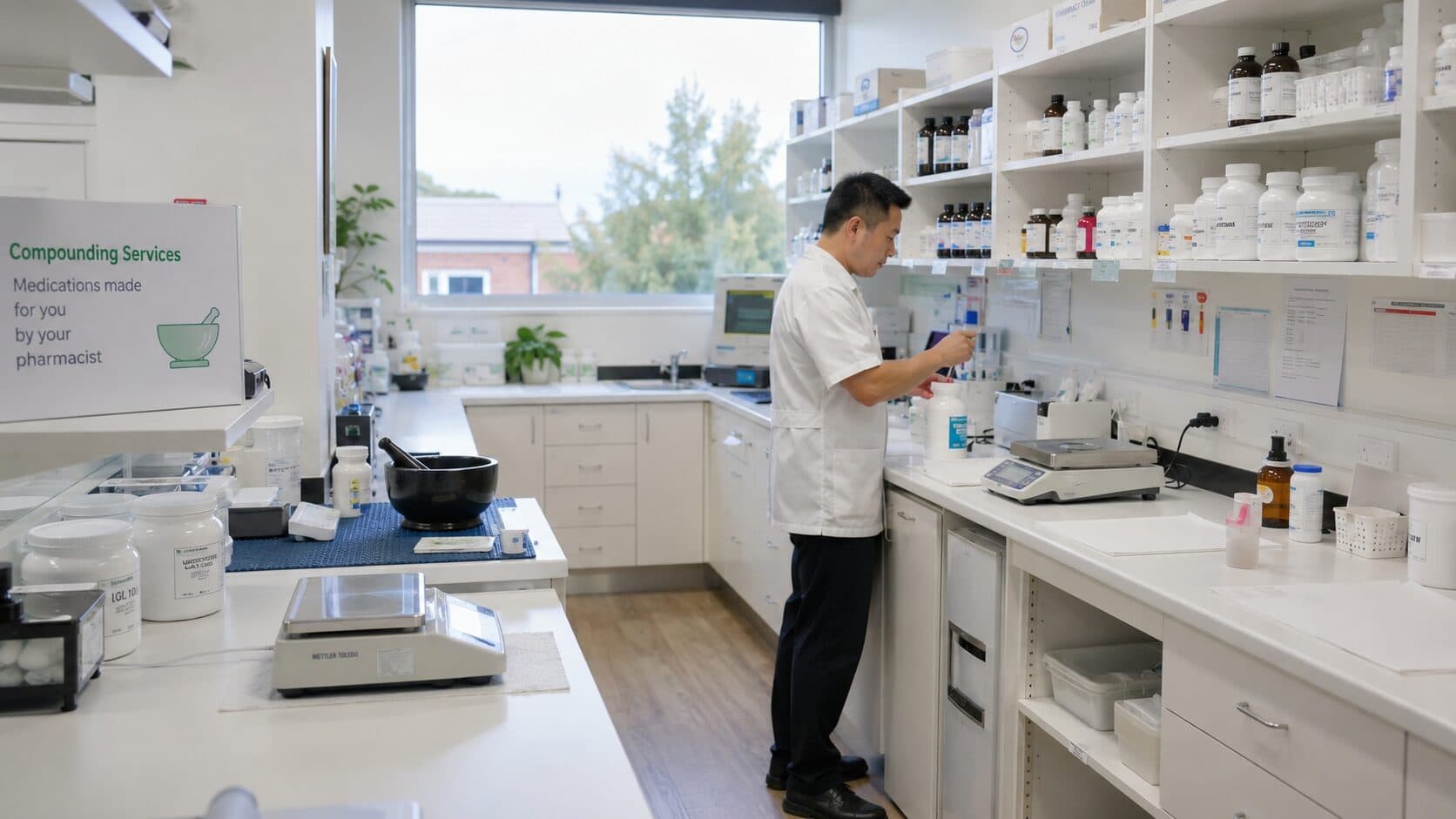
A compounding pharmacy prepares medicines individually for one patient, mixing ingredients to a doctor's prescription. Most pharmacies don't compound; specialist compounders maintain the equipment, training, and quality systems required under the Pharmacy Board's compounding guidelines. Compounding kicks in when a commercial product doesn't meet a patient's specific needs: a different dose, a tablet-to-liquid conversion for someone who can't swallow tablets, an allergen-free formulation, a discontinued strength, or a paediatric or veterinary preparation.
The regulatory framework was rewritten in October 2024. Costs and how to find a compounder are below.
What compounding is
Compounding is the measurement, mixing, preparation, packaging, and labelling of a medicine made specifically for one patient based on a doctor's prescription. The compounder works with raw ingredients (powders, oils, bases) rather than mass-produced finished products.
There are two main types:
- Non-sterile compounding: capsules, creams, gels, oral liquids, troches, and other preparations that don't need to be sterile. Most compounding pharmacies do this.
- Sterile compounding: injections, ophthalmic preparations, and some inhalations. These require dedicated cleanroom facilities and additional certification. Far fewer pharmacies are equipped for sterile compounding.
The Pharmacy Board of Australia's revised Guidelines on Compounding of Medicines (released October 2024) tightened standards for both types, particularly around documentation, equipment validation, and risk assessment. Pharmacies that compound have updated their processes accordingly.
When you might need a compounded medicine
Common reasons a doctor prescribes a compounded preparation:
1. The commercial product doesn't suit you
- Allergy to a filler, dye, lactose, gluten, or preservative in the off-the-shelf version
- Need for a flavour to make a paediatric preparation acceptable
- Need for a different formulation (e.g. liquid instead of tablet for someone with swallowing difficulty)
2. The dose isn't commercially available
- A patient needs a dose that's between two commercial strengths
- The prescriber wants a specific titration curve a manufacturer doesn't make
- A discontinued strength needs to be reproduced
3. Combination products
- Two or more active ingredients combined into a single capsule or cream when the manufacturer doesn't produce a combination
4. Paediatric and geriatric needs
- Tablet-to-liquid conversion for children under five who can't swallow tablets
- Smaller doses for elderly patients sensitive to standard adult strengths
5. Veterinary medicine
- Many compounding pharmacies prepare medications for animals, especially cats, dogs, and exotic pets, where commercial veterinary products are limited
6. Hormone replacement therapy
- Some doctors prescribe bioidentical hormone preparations as compounded creams or capsules. These compounded products are not individually assessed by the TGA for safety or effectiveness, and the TGA has published cautions about compounded bioidentical hormones, so they do not carry the same evidence base as approved hormone therapies. Talk to your GP and pharmacist about whether a compounded preparation is appropriate in your case.
7. Specialised dermatology
- Compounded creams, gels, and ointments for specific skin conditions where commercial products are unavailable or unsuitable.
What compounding costs
Compounded medicines are generally not PBS-subsidised. The cost is paid privately, sometimes with a private-health-insurance rebate. Typical price ranges in 2026:
- Capsules: price varies per 30 to 60 doses, depending on active ingredients and complexity
- Creams and gels: price varies per jar (jar size and active ingredient drives the variation)
- Oral liquids and suspensions: price varies per bottle
- Sterile preparations: significantly more per dose, due to cleanroom and quality-control overhead
- Veterinary compounds: variable, generally cheaper than equivalent human compounds
Some private health funds rebate part of the cost under their general extras cover. Check with your fund before paying.
A compounded medicine costs more than its closest commercial equivalent because the pharmacist's time, ingredient costs, and quality systems all factor in. The cost is not a markup; it reflects genuine production overhead per individual preparation.
The October 2024 Pharmacy Board guidelines
The Pharmacy Board of Australia released revised Guidelines on Compounding of Medicines in October 2024, replacing the previous 2015 framework. Key changes that affect what pharmacies can offer:
- Tighter documentation requirements for every compounded preparation
- More rigorous risk assessment categorisation (simple, moderate, complex)
- Required validation of equipment and procedures
- Limits on commercial-scale compounding without additional registration
- Specific guidance on sterile compounding facilities and processes
For consumers, the practical effect is that compounding pharmacies have invested in updated systems, and some smaller operators have stopped offering complex compounding rather than meet the new standards. Specialist compounders remain in capital cities and major regional centres.
The 2025 GLP-1 changes
In late 2024 and 2025, the TGA tightened rules on compounding of GLP-1 receptor agonists (a class of medicines used in diabetes and weight management). Several compounded GLP-1 preparations were withdrawn from compounding eligibility. Patients previously using compounded GLP-1 products were advised to talk to their GP about commercially available alternatives where appropriate.
The current TGA position is documented at tga.gov.au; ask your prescriber for the current status of any specific compounded preparation.
How to find a compounding pharmacy
Most major Australian cities have specialist compounders. Approaches:
- Ask your GP. GPs often have working relationships with compounders they trust.
- Search Pharmacy Finder by service. We tag pharmacies that offer compounding. See pharmacies offering compounding.
- The Australasian Society of Compounding Pharmacists at ascp.net.au maintains a member directory.
- Ask in a long-existing health forum or condition-specific support group. Compounding patient communities often share recommendations.
For sterile compounding (injectables, ophthalmics), the network is smaller. Talk to your prescriber about which sterile compounder they recommend.
What the pharmacist needs from your prescription
A compounded prescription must specify:
- The active ingredients (substance names, not brand names)
- The strength of each ingredient
- The form (capsule, cream, gel, liquid, etc.)
- The vehicle or base (where relevant; the pharmacist may select)
- The total quantity to be supplied
- Dosing instructions
- The patient's name (compounding is one-patient-only; this is regulatory, not preference)
If your prescription is missing any of these, the compounding pharmacy will call your prescriber to clarify before starting.
Talk to someone now
Free advice for questions about a medicine, dose, or interaction.
Frequently asked questions
Most non-sterile compounded preparations cost $30 to $120 per supply, depending on form, active ingredients, and complexity. Sterile preparations are significantly more expensive due to cleanroom overhead. Compounded medicines are generally not PBS-subsidised; private health insurance may rebate part of the cost.